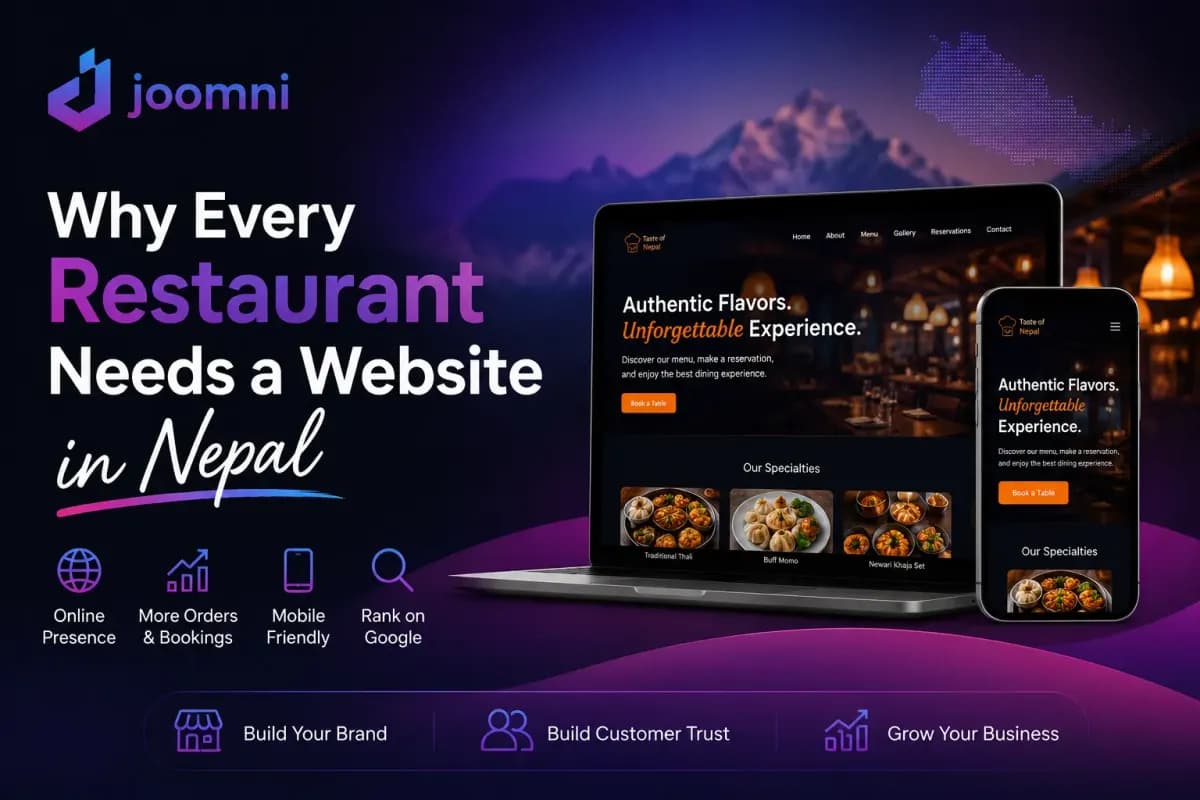
A hungry couple is walking down a street in Jhamsikhel. They pull out a phone and type "best momo near me." Three restaurants appear on Google with photos, hours, and a menu link. Yours isn't one of them, even though you're two doors down and your kitchen is better.
That's not a marketing problem. That's a visibility problem.
Thousands of restaurants across Kathmandu, Pokhara, Biratnagar and beyond run their entire digital presence through a Facebook page and a WhatsApp number. It works, until it doesn't. In 2026, a restaurant website in Nepal isn't a luxury for big hotel chains. It's the one piece of digital property you actually own, and it's often the difference between being found and being forgotten.
Here's why it matters, what it's quietly costing you not to have one, and exactly how to fix it without hiring a developer.
1. Social Media Alone Isn't Enough Anymore
Facebook and Instagram are excellent for reminding people you exist. They're far weaker at being found by people who don't already know you.
You don't own your audience
If your page gets restricted, hacked, or mistakenly flagged, you lose everything overnight: your photos, your reviews, your customer messages, your follower list. This has happened to real restaurant owners in Nepal, who had to rebuild their entire online presence from zero after losing access to a page they'd spent years growing. There's often no fast appeal process, no phone number to call, and no guarantee the page ever comes back.
A website is different. The domain is yours. The hosting is yours. The content is yours. Nobody can switch it off because of a policy change, a flagged photo, or an algorithm update you had no say in. This is the same trade-off Nepali sellers face on marketplaces, which we broke down in Daraz vs your own website: rented reach is fast to start and expensive to depend on.
The algorithm decides who sees you
You might have 12,000 followers, but a typical organic post reaches only a small fraction of them . You're renting attention, and the rent keeps rising every year. Platforms increasingly push paid promotion, which means visibility now costs real money that could otherwise go into your kitchen, your staff, or your ingredients.
Social posts disappear; websites compound
Your Tihar special post from last year is buried under 300 newer posts, invisible within days. But a well-structured page on your own site (your menu page, a page about your story, a post about your specialty dish) keeps working for you every single day, for years, and often ranks better on Google the longer it exists rather than fading like a social post does.
You can't fully control the experience
On Facebook, a customer sees your post sandwiched between ads, unrelated content, and posts from other pages they follow. On your website, every pixel is about your restaurant: your food, your story, your atmosphere, your voice. That control matters more than most owners realize when it comes to first impressions, especially for customers who've never been to your restaurant before and are deciding whether to trust it.
Social media has no memory
A new follower today has no idea what you posted eight months ago unless they scroll for a long time. A website's menu page, about page, and gallery are always there, fully formed, the moment someone lands on it. No scrolling through history required.
2. Google Visibility: Where Hungry Customers Actually Start
Think about how you find a plumber, a dentist, or a new café you haven't tried. You search.
Your customers do the same thing. Every day, people across Nepal search for things like:
- "restaurants near me"
- "best Newari khaja ghar Kathmandu"
- "rooftop restaurant Lakeside Pokhara"
- "restaurants open now near Thimi"
- "family restaurant for birthday party Kathmandu"
- Or simply your restaurant's name, because someone recommended it over the phone
Without a website, you're mostly invisible for the first few of these. And for the last one, someone searching your name might land only on a half-updated review site, an old blog mention, or (worse) a competitor's paid ad sitting above anything about you at all.
Tourists and out-of-towners search before they arrive
This matters enormously in Thamel, Pokhara, Sauraha, and Nagarkot. Visitors research where to eat before they land, often days in advance, comparing menus, prices, and photos across a shortlist of options. They're not scrolling your Instagram feed hoping to stumble on you. They're Googling, reading, comparing, and deciding. A website with your cuisine, price range, location, and photos is what gets you into that shortlist in the first place. Miss that shortlist, and it doesn't matter how good your food is: they never walk through the door.
A website makes your Google Business Profile stronger
Your free Google Business listing lets you attach a website link. That link builds credibility with Google's ranking system, gives searchers somewhere to go deeper, and signals that your listing is actively maintained rather than abandoned. Restaurant digital presence in 2026 is really a two-part system: your Google listing brings people to your door, your website closes the deal by answering every follow-up question before they even ask it.
If you haven't set up or claimed your listing yet, start with our step-by-step guide to local SEO and ranking for "near me" searches in Nepal. It covers category selection, map pin placement, and how to get reviews from Nepali customers over Viber and WhatsApp.
Local SEO compounds over time
Every well-optimized page (your homepage, your menu, a page about your location or story) is another chance to show up for a relevant search. Restaurants with a real website consistently outrank those without one for local searches, simply because there's more indexable content tied to their name and location. This advantage builds month after month; a website you launch today keeps earning search visibility a year from now with almost no extra effort. The same SEO fundamentals that work for online stores apply directly to restaurant pages.
Voice search and mobile search are growing
More customers are searching by voice ("find a restaurant near me open now") while walking or driving, and increasingly they're asking AI assistants instead of typing into a search box. These searches favor businesses with structured, accurate, up-to-date information across their Google listing and website. Our guide to answer engine optimization explains how to write pages that these systems can actually quote. A stale or missing website actively works against you here.
3. Trust and Credibility: Looking Like a Real, Established Business
Let's be honest about how people judge restaurants online before they've ever eaten there.
A clean website with real photos, clear pricing, and a proper address signals: this place is established, it's serious, and it will still be here next month. A Facebook page with a blurry cover photo from 2021 and no recent activity signals something else entirely, even if the food itself is excellent.
This matters most when the stakes are higher than a casual dinner:
- A family booking a birthday dinner for 20 people
- A company organizing an office lunch or year-end party
- A wedding party comparing catering options
- A corporate client shortlisting three venues for an event
- A group of tourists deciding where to spend their one big dinner in the city
- A food blogger or reviewer researching before a visit
These customers want to see a menu, a seating capacity, a phone number, and photos of the actual space, all in one place, without messaging you and waiting hours for a reply that may or may not come. If they can't find that information quickly, they book somewhere they can. Every hour of delay is a chance for a competitor to close the sale first.
A website signals permanence
Anyone can open a Facebook page in five minutes and disappear in six months. A registered domain, a proper "About" page with your story, and a real address say something different: this is a business that plans to be here, that has invested in itself, and that takes its customers seriously enough to be easy to find and easy to trust. If you're formalising the business at the same time, our guide to company registration for online businesses in Nepal covers the paperwork side.
4. Your Online Menu and Ordering System
Ask your staff how many phone calls a day are just people asking "What's the price of chicken thali?" or "Do you have veg options?" or "Is it spicy?"
That's friction. Every one of those calls is a customer who almost gave up, and every missed call (during a rush, when your line is busy, when a staff member can't get to the phone) is one who did.
An online menu solves this instantly
An online menu for restaurant customers should be a proper page on your own site, not a photo of a laminated card that nobody can zoom into or read comfortably on a phone screen. A proper digital menu lets you:
- Update prices in minutes when vegetable, meat, or gas costs change
- Mark items veg, non-veg, spicy, or allergen-relevant
- Show today's specials without reprinting a single card
- Let customers zoom, scroll, and read comfortably on mobile, where most browsing happens
- Organize by category (starters, mains, drinks, desserts) so decision-making is fast
- Highlight bestsellers or chef's recommendations to guide undecided customers
How you write each item matters more than owners expect. The same principles behind writing product descriptions that rank apply to dish names and descriptions, and they're part of why a menu page can pull in searches a Facebook post never will.
Owning your ordering channel protects your margins
Delivery apps brought you customers, and that's genuinely valuable: they solve discovery. But commissions on every order add up fast, and the customer relationship belongs to the app, not to you. You don't get their number, their order history, or a way to bring them back without paying the platform again for the same customer, every single time.
A restaurant online ordering system on your own website changes that math. Regulars who already love your food can order direct for pickup or delivery. You keep the full amount, you keep the customer's contact details, and you can bring them back with an offer next month: a loyalty discount, a festival special, a "we miss you" message. Setting those up once and letting them run is what automated email and messaging campaigns are for.
Many successful restaurants use delivery apps for discovery and their own site for repeat business. That combination works well and protects margins on your most loyal customers, who are usually your most profitable ones.
With digital wallets like eSewa and Khalti now standard across Nepal, taking payment directly through your own website is no longer complicated or expensive to set up.
A simple way to picture the savings
Imagine a regular customer who orders NPR 1,500 worth of food twice a month through a delivery app charging a 25 percent commission. That's roughly NPR 750 in commission every month, or NPR 9,000 a year, from just one customer. Multiply that across dozens of regulars, and the case for offering direct ordering on your own site becomes hard to ignore.
You can run your own numbers with our payment fee calculator to see what you'd actually keep per order on different payment methods.
5. Reviews, Photos, and Reservations: All in One Place
Your reputation is currently scattered across Google, Facebook, TripAdvisor, delivery apps, and word of mouth. Your website is where you pull all of it together into one coherent story.
A good restaurant site brings together:
- A photo gallery: your food, your interior, your rooftop view, taken properly and consistently, not a mix of blurry customer uploads
- Featured reviews: the best things customers have already said, pulled out and placed front and center instead of buried in a feed
- A reservation form: so table bookings arrive as structured requests (date, time, party size) instead of scattered midnight WhatsApp messages you might miss
- Practical details: hours, parking availability, Wi-Fi, delivery zones, and whether you're open during festivals or public holidays
- Your story: how the restaurant started, what makes your cuisine or recipes distinct, which builds emotional connection that a menu alone can't
That "are they open today" question is underrated. It's one of the most common things a customer wants to know before heading out, and a website answers it instantly, without anyone picking up the phone or waiting on a reply that might come too late.
Website vs. Facebook Page
Ownership
- Facebook: platform-controlled, and can be restricted or lost
- Website: fully owned by you
Discoverability on Google
- Facebook: very limited
- Website: strong, and improves over time
Reach to new customers
- Facebook: shrinking due to algorithm limits
- Website: unlimited to anyone who searches
Menu experience
- Facebook: a static photo, hard to read or update
- Website: interactive, mobile-friendly, and easy to update
Online ordering
- Facebook: none built in, so you rely on messages or third-party apps
- Website: direct and commission-free
Reservations
- Facebook: manual, via messages or comments
- Website: a structured booking form
Credibility for events and corporate bookings
- Facebook: lower
- Website: higher, because it looks established
Long-term cost
- Facebook: "free," but paid for in lost commissions and ad spend
- Website: low ongoing cost, with higher long-term return
Content lifespan
- Facebook: days, before a post is buried
- Website: years, and it stays searchable
The takeaway isn't "abandon Facebook." It's that a website fills in every gap Facebook can't cover, and the two work best as a pair.
What a Restaurant Website Actually Needs: A Simple Checklist
If you're about to build one, don't overcomplicate it. A restaurant website that does its job needs:
- Homepage: restaurant name, cuisine, standout photo, location, and a clear call-to-action (view menu, order now, book a table)
- Menu page: categorized, mobile-friendly, with prices and veg/non-veg/spicy indicators
- Online ordering or a clear ordering path: direct ordering, or at minimum a clickable phone number and WhatsApp link
- Photo gallery: food, interior, and exterior shots, ideally professional or at least well-lit
- About/story page: why you started, what makes your food or approach different
- Location and hours: embedded map, address, opening hours, and holiday exceptions
- Reviews or testimonials: pulled from Google or customers directly
- Reservation form: even a simple one that captures date, time, and party size
- Contact details: phone, WhatsApp, email, and social links
- Mobile optimization: since the vast majority of your visitors will be on a phone, not a desktop
You don't need all ten on day one, but items 1 to 4 are the non-negotiable starting point.
If you also run a counter or takeaway window, connecting your menu to a point-of-sale system means your online and in-person prices never drift apart, which is a surprisingly common source of customer complaints.
A Realistic Scenario: What Changes After Launch
Consider two similar restaurants in the same neighborhood, both serving good food at similar prices. One runs only a Facebook page. The other adds a simple website with a menu, photos, and a Google Business link.
The Facebook-only restaurant depends entirely on existing followers seeing new posts and on walk-by foot traffic. New customers from outside that circle (tourists, people new to the area, anyone searching online) largely never find it.
The restaurant with a website starts showing up when people search its cuisine and neighborhood. Its Google Business listing looks more complete and trustworthy because it links somewhere real. Corporate and event inquiries increase because organizers can see capacity and menu details without waiting on a reply. None of this requires the food to change. Only the visibility does.
This is the pattern behind most of the "why didn't we do this sooner" reactions from restaurant owners after launching a website: the food was never the problem. Being found was. You can see how other Nepali businesses have handled the same shift in our customer success stories.
6. "But Websites Are Expensive and Complicated"
This is the single biggest reason restaurant owners stay stuck, and it's based on outdated information about what building a website actually takes.
The old model meant hiring a developer, waiting weeks for a first draft, then paying again every single time you wanted to change a price or add a dish. No wonder so many owners avoided it and stuck with Facebook instead. We broke the current numbers down properly in what a website actually costs in Nepal in 2026.
That model is gone. Modern AI-powered website builders let you set up a professional restaurant site yourself, without touching a single line of code, often in a single afternoon. A restaurant is only one of the types of sites you can now build without a developer.
The real question isn't "can I afford a website?" It's "how many customers am I quietly losing each month without one?" A handful of extra table bookings or online orders usually covers the entire cost many times over, often within the first month.
Nepali ma padhna chahanuhunchha? Hamro website kasari banaune guide hernuhos.
Frequently Asked Questions
Do I still need a website if I already have a Facebook page?
Yes. A Facebook page and a website do different jobs. Facebook keeps existing followers updated with posts and offers, but it's weak at being discovered by new customers searching Google, and you don't control or own that page the way you own a website. The two work best together: Facebook for engagement, your website for discovery, credibility, and direct ordering.
How much does it cost to build a restaurant website in Nepal?
Costs vary widely depending on the approach. Hiring a developer from scratch traditionally costs tens of thousands of rupees and takes weeks. Modern website builders let you build a professional restaurant site yourself for a fraction of that cost, with no separate design or development fees, and you can be live the same day. Our pricing page shows current plans.
Do I need technical or coding skills to build one?
No. AI-powered builders are designed for business owners, not developers. You describe your restaurant, add your menu items and photos, and the platform handles the layout, structure, and technical setup automatically.
Will a website actually help my restaurant show up on Google?
A website is one of the strongest signals you can give Google that your business is real, active, and relevant to local searches. Combined with a well-maintained Google Business Profile, a website with proper menu pages, location details, and regularly updated content significantly improves your chances of appearing in searches like "restaurants near me." Our local SEO guide for Nepal walks through the Google Business Profile side step by step.
Can I take orders directly through my website instead of only through delivery apps?
Yes. A restaurant website with built-in ordering lets customers order pickup or delivery directly from you, with local payment options like eSewa and Khalti. This means no commission cut going to a third-party app for orders from customers who already know and love your food.
What happens to my online presence if my Facebook page gets restricted or removed?
If your only digital presence is a Facebook page, a restriction, hack, or policy flag can wipe out your reviews, photos, and follower base overnight, with no guaranteed way to recover it. A website is hosted on your own domain, so it stays fully under your control regardless of what happens on any social platform.
How long does it take to launch a restaurant website?
With a traditional freelance developer, expect anywhere from two to six weeks. With an AI-powered builder, a restaurant can go from no website to a live, mobile-friendly site with menu and ordering in as little as a day. Our getting started guide covers the launch steps.
Do I need a website if most of my customers already know me by word of mouth?
Word of mouth is powerful, but it only reaches people who already know someone who's eaten at your restaurant. A website extends that reach to new customers (tourists, people who just moved to the area, or anyone searching online) who would otherwise never hear about you at all.
Can a website help with catering or event bookings, not just regular dining?
Yes, often more than people expect. Corporate clients and event organizers typically shortlist venues by researching online first. A website with clear capacity details, catering menus, and photos of your space gives you a real chance at bookings that never would have reached you through Facebook or word of mouth alone.
Do I need to keep updating the website constantly once it's live?
Not constantly, but regularly. Keeping your menu, prices, and photos current matters both for customer trust and for how well the site performs in search results. A good builder makes these updates quick enough to do yourself in minutes, without waiting on a developer.
What's the single biggest mistake restaurants make with their online presence?
Treating social media as a complete substitute for a website. Social platforms are excellent at engagement but weak at discovery, ownership, and credibility: the three things a website is specifically built to solve. The strongest setup uses both together rather than relying on either alone.
Building Your Restaurant Website with Joomni
This is exactly what we built Joomni for: helping Nepali businesses get online without needing a developer, a designer, or a technical background.
For restaurants specifically, Joomni includes:
- Menu management: add dishes, update prices, mark items unavailable, all from your phone
- Online ordering: take pickup and delivery orders directly, with local payment options
- SEO-friendly design: pages built so Google can find and rank them for local searches
- Mobile-first layouts: because nearly all your customers are browsing on a phone
- Built-in reservation and contact forms: so bookings and inquiries land in one place, not scattered across apps
You describe your restaurant, and the AI builder handles the structure and design. You focus on the food.
The Bottom Line
Social media is your conversation with customers. Your website is your address.
Understanding the benefits of a website for restaurant business owners comes down to one idea: every other platform is borrowed ground. The algorithm can change, the app can raise its commission, the page can vanish overnight. Your website is the only part of your digital presence that answers to you: today, next year, and for as long as your restaurant is open.
Your food already earns loyalty. Make sure people can actually find it.
Ready to get your restaurant online? Start building with Joomni today. No coding, no developer, no waiting.
Written by
Admin