Remember when reaching page one of Google felt like winning something? That still matters. But it is no longer the only place discovery happens.
A meaningful share of product and service research now happens inside AI assistants. Someone asks ChatGPT which laptop to buy, asks Perplexity to compare two services, or reads a Google AI Overview and never scrolls to the blue links underneath. The research phase finishes before anyone visits a website.
If your business is not part of what the AI says, you were not in that customer's decision at all. Not because your product is worse. Because the system either did not know about you or did not consider your information solid enough to cite.
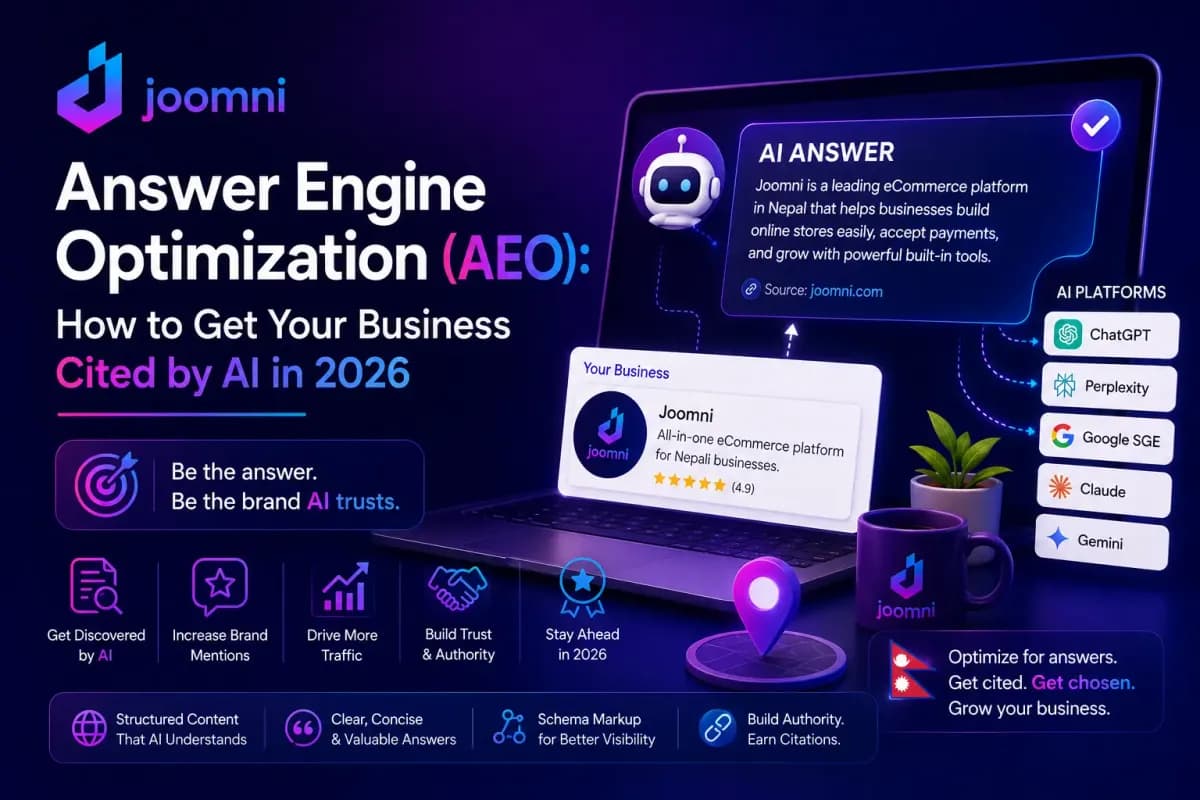
Answer Engine Optimization is the work of making your content easy for AI systems to extract, understand, and quote. Instead of competing for a position in a list, you are trying to become part of the answer.
This guide covers what actually works, what has changed recently that most AEO advice has not caught up with, and where the opportunity is unusually large for businesses in Nepal.
What's in this guide
- A note on the statistics in AEO articles
- What AEO actually is
- How AEO differs from SEO
- Why this matters unusually much in Nepal
- Structure content for extraction
- Structured data, and what actually still works
- Entity clarity
- Conversational queries
- Off-site authority
- Freshness
- Common mistakes
- Measuring AEO without expensive tools
- A four-week start
- Frequently asked questions
A Note on the Statistics in AEO Articles
AEO content is unusually full of confident numbers: query volumes, market shares, conversion multiples, adoption forecasts.
Treat them carefully. Most circulate without a named source or date. Many come from vendors selling AEO tools, which is not a neutral position. Some contradict each other, and a few contradict themselves within the same article.
The underlying shift is real and worth acting on. The precise figures are mostly not verifiable, so this guide describes direction and mechanism rather than quoting numbers that will be stale or wrong by the time you read them.
Where you do want figures for your own planning, get them from the platforms themselves or from named research with a publication date attached.
What AEO Actually Is
Answer Engine Optimization is structuring your content so AI systems can extract, understand, and cite it when answering a user's question.
With traditional SEO, success meant appearing in a list. A person saw your title and description and decided whether to click.
With AEO, the AI reads your content, processes it, and folds your information into its response. Your brand might be named. Your data might be quoted. Your explanation might be summarised. The user may get their answer without visiting you at all.
That sounds alarming. Why optimise for something that might not send traffic?
Because people are using these tools whether you optimise or not. The question is not whether AI search happens. It is whether you are in the conversation when it does.
And the traffic that does arrive this way tends to be better. Someone who clicks through after an AI recommended you arrives already trusting the source.
How AEO Differs from SEO
Not a replacement. An addition.
Traditional SEO optimises for keywords, links, and technical health, aiming at clicks. You measure traffic, rankings, and conversions.
AEO optimises for clarity, structure, and quotability, aiming at citations. You measure how often you are mentioned, how you are described, and whether you appear when someone asks about your category.
A practical example. Say you sell trekking equipment.
The SEO play: rank for "trekking backpack Nepal" and compete for the click.
The AEO play: structure your content so that when someone asks an assistant "what backpack should I take for the Annapurna Circuit in October," your products and your guidance appear in the answer.
You need both. Google still sends enormous traffic, and many AI systems draw on traditional search results to build their answers. Good SEO is the foundation AEO sits on. Our complete ecommerce SEO guide covers that foundation.
Why This Matters Unusually Much in Nepal
Here is the part no international AEO guide will tell you.
Almost nobody here is doing this. Most Nepali businesses have no structured data, inconsistent business information across platforms, and thin content that answers no questions directly. When an AI assistant is asked to recommend a clinic in Lalitpur or a trekking operator in Pokhara, it has very little quality local material to draw on.
That is an opening. AEO rewards clarity and expertise more than domain authority or budget, which means a small Nepali business with genuine knowledge can be cited as readily as a large one.
Three specific opportunities:
Local recommendations. AI assistants increasingly answer location-based questions. "Best momo in Thamel," "physiotherapy clinic near Baneshwor," "reliable trekking guide Pokhara." These answers get built from Google Business Profiles, review content, and websites with clear location and service information. Most of your competitors have none of that in usable form. Our guide to local SEO and Google Maps in Nepal covers the groundwork, and it doubles as AEO work.
International buyers researching Nepal. Someone planning a trek, buying pashmina, or sourcing handicrafts often starts by asking an AI assistant. The businesses that appear in those answers capture buyers who have not yet found any website. For exporters and tourism businesses this is one of the highest-value opportunities available right now.
Nepali-language and bilingual queries. AI assistants handle Nepali reasonably well now, and there is very little quality Nepali content for them to draw on in most commercial categories. Publishing clear Nepali content is close to uncontested.
Strategy 1: Structure Content for Extraction
AI systems work best with clear, well-organised content. Structure is not decoration here, it is the mechanism.
Answer first. Lead each section with the direct answer, then expand. If someone asks how long delivery takes, the first sentence should say "Most orders inside Kathmandu Valley arrive within 1 to 2 days," not build up to it after three paragraphs about your logistics partners.
Use question-based headings. "What makes this different?" beats "Our Advantages." "How long does delivery take outside Kathmandu?" beats "Shipping Information."
Write complete statements, not fragments. "Material: pashmina" is difficult to quote. "This shawl is made from 100% Chyangra pashmina" can be lifted whole into an answer. This single habit does more for citability than most technical work.
Keep blocks short and scannable. Two to four sentence paragraphs. Bullets and numbered lists, which systems extract from more reliably than dense prose.
Be specific. Vague marketing language gets skipped in favour of content with concrete detail. Dimensions, materials, prices, timeframes, and locations all make you more quotable.
The same principles apply to product pages, which we cover in writing product descriptions that rank.
Strategy 2: Structured Data, and What Actually Still Works
Schema markup tells machines what your content represents. But the advice you will read elsewhere is out of date, and following it wastes effort.
What changed
FAQ rich results no longer appear in Google. Google deprecated FAQ rich results on 7 May 2026, removing the expandable question dropdown from search results for all sites, including the government and health sites that had retained eligibility after the 2023 restriction. Search Console reporting was dropped the following month.
HowTo rich results are also gone. Google removed them from mobile in August 2023 and from desktop in September 2023. No HowTo rich result exists on any surface today.
Most AEO articles still recommend both as priorities. They are not, at least not for the reason usually given.
What this means practically
Still worth implementing:
- Product schema if you sell anything. Price, availability, ratings, and specifications are exactly what AI systems use when making product recommendations. This is the highest-leverage markup on this list for an online store.
- Organization schema to define your business as a clear entity, with your name, logo, and social profiles.
- LocalBusiness schema if you have a physical location. Address, hours, service area, and contact details.
- Article schema on content, with author and dates, which supports both freshness signals and author credibility.
- BreadcrumbList, which still produces a visible search feature.
FAQPage schema is optional now. It produces no Google rich result, but it remains valid schema.org and other crawlers parse it. Include it if it costs you nothing. Do not build a strategy on it, and do not expect a click-through lift.
HowTo schema can be skipped entirely. Use properly structured numbered lists in your HTML instead, which is what helps here regardless of markup.
One thing worth stating plainly: Google has said there is no special markup required for AI Overviews or AI Mode. Schema helps machines understand you, which indirectly helps. It is not a switch that turns on AI citations.
Most platforms handle the basics automatically. Check what yours outputs and validate it with Google's Rich Results Test. SEO settings is where to look on Joomni.
Strategy 3: Entity Clarity
AI systems think in entities, not just keywords. Your business is an entity. Your products are entities. For a system to cite you confidently, it needs to be sure it knows who you are.
Consistency is the whole game. The same business name, address, phone number, and description everywhere online. Variations make systems uncertain whether they are looking at one business or several, and uncertainty means they skip you.
Where to fix this in Nepal:
- Google Business Profile, completely filled in
- Facebook Page, usually the worst offender with an outdated number
- Instagram bio
- Nepal Yellow Pages and local directories
- Foodmandu, Bhojdeals, or Pathao Food if you are a restaurant
- Hamrobazar listings
- Your own site's contact page and footer
Pick one exact version of your details, write it down, and update everything to match, character for character. Our local SEO guide covers this in more detail, since the same consistency work drives Maps rankings too.
Establish who is behind the business. Author bios with real credentials. An about page that says who runs this and why they know what they are talking about. AI systems look for signals of expertise before citing.
Strategy 4: Write for Conversational Queries
People phrase things differently to an AI than to a search box.
Not "running shoes women" but "what running shoes work best for flat feet." Not "gym Kathmandu" but "which gym in Kathmandu has personal trainers and opens early."
Find the real questions. They already exist:
- Questions your customers actually ask you, on Viber, on Messenger, over the phone
- Comments on your social posts
- Reviews mentioning specific problems or use cases
- Reddit and Quora threads in your category
Then answer them directly. Not by inserting keywords, but by writing the answer clearly enough to be quoted.
A Nepal-specific note: many of your customers will ask in Nepali or Romanised Nepali. Publishing clear content in Nepali is genuinely uncontested in most categories, and AI systems handle Nepali well enough now to use it. See our Nepali guide for an example of the format.
Strategy 5: Off-Site Authority and Citations
AI systems favour information corroborated by sources they already trust. Being mentioned elsewhere strengthens your entity considerably.
What builds it:
- Coverage in industry publications and local news
- Genuine contributions to communities where your expertise is relevant
- Listings on legitimate directories and association sites
- Reviews on platforms that AI systems read, particularly Google
Quality far outweighs quantity. One mention in a genuinely authoritative source is worth more than fifty directory listings on sites nobody reads.
For Nepali businesses, local media coverage, industry association membership, and a strong Google review profile are usually more achievable and more useful than chasing international publications.
Strategy 6: Keep Content Current
AI systems favour recent information, and stale content gets deprioritised.
Set a refresh rhythm. Review your most important pages quarterly. Update prices, statistics, and examples. Remove things that are no longer true.
Show your dates. Published and last-updated dates signal currency to both readers and machines.
Keep facts consistent across your site. If your product page says one thing and your specs table says another, a system has no way to resolve the conflict and will often skip you rather than risk being wrong.
Common AEO Mistakes
Keyword stuffing for AI. Backwards. These systems understand natural language. Write clearly and they understand you.
Abandoning SEO fundamentals. AEO sits on top of good SEO. You still need speed, mobile performance, crawlability, and quality content.
Chasing deprecated schema. As covered above, FAQ and HowTo rich results no longer exist. Spending a week implementing them for a SERP feature that was removed is wasted effort.
Ignoring local signals. If you serve a specific area, AI assistants personalise by region. Make your location and service area unmistakable.
Blocking AI crawlers. Some publishers block AI bots. That guarantees invisibility in AI answers. Unless you have a specific reason, allow them.
Thin, generic content. Systems favour specificity. "We offer quality products at competitive prices" is unquotable. "We deliver inside Kathmandu Valley within 24 hours and to major cities within 3 days" is quotable.
Treating it as a project rather than a practice. These systems keep changing. So does everyone else's content.
Measuring AEO Without Expensive Tools
Most AEO articles recommend monitoring platforms costing hundreds of dollars monthly. For a Nepali business that is rarely justified, and the free version of this works well enough.
Ask the assistants directly. Once a month, ask ChatGPT, Perplexity, and Google's AI features the questions your customers would ask. "Best trekking gear shop in Kathmandu." "Where to buy authentic pashmina online." Note whether you appear, how you are described, and who appears instead.
Keep the answers in a spreadsheet. Month over month, that is a genuine visibility trend.
Watch branded search. When AI systems start recommending you, people search your name directly afterwards. A rise in branded search in Google Search Console is one of the clearest available signals that AI mentions are happening.
Check referral traffic. Analytics will show visits from ChatGPT, Perplexity, and similar sources. Small numbers, but they indicate you are being cited.
Ask customers how they found you. Still the best attribution method available, and the only one that catches discovery no tool sees.
A Four-Week Start
Week 1: audit. Ask the major AI assistants about your business and your category. Write down what they say. This is your baseline and it usually takes an hour.
Week 2: fix entity consistency. One exact version of your business details, applied everywhere. Complete your Google Business Profile fully. This is the highest-return week of the four.
Week 3: restructure your top five pages. Answer-first openings, question-based headings, complete factual statements, short paragraphs. Check your Product and Organization schema is present and valid.
Week 4: publish one properly answer-focused piece. Take the question your customers ask most and answer it thoroughly, clearly, and specifically.
After that, a sustainable rhythm: one answer-focused piece every week or two, a quarterly refresh of key pages, and a monthly check of what the assistants say about you.
Frequently Asked Questions
What is the difference between AEO and SEO?
SEO optimises for ranking in search results to earn clicks. AEO optimises for being cited inside AI-generated answers. They share tactics like quality content and clear structure, but AEO puts more weight on answer-first formatting, factual specificity, and entity consistency. Do both.
Do I still need SEO if I am doing AEO?
Yes. Google still drives enormous traffic, and many AI systems build answers partly from traditional search results. Good SEO is the foundation AEO sits on, not something it replaces.
Should I implement FAQ schema for AEO?
It is optional now. Google deprecated FAQ rich results in May 2026, so it will not earn you a search feature or lift your click-through rate. It remains valid schema.org markup that other crawlers can parse, so include it if it is easy. Product, Organization, LocalBusiness, and Breadcrumb schema are better uses of your time.
How long does AEO take to work?
Expect first mentions within a few months of systematic work, with meaningful visibility building over six months to a year as your entity strengthens and your content library grows. Entity consistency fixes can show up faster than content work.
Can a small Nepali business compete at this?
Yes, and more easily than in traditional SEO. AEO rewards clear expertise over domain authority and budget. In most Nepali categories almost nobody is doing this work, which means the bar for being the clearest available source is unusually low right now.
Which platforms should I focus on?
ChatGPT and Google's AI features first, since they have the widest reach. Perplexity is worth watching because it is built around citation and consistently attributes sources. Beyond that, focus effort on being clear and structured rather than optimising per platform, since they largely reward the same things.
Do I need paid AEO tools?
Not to start. Asking the assistants your customers' questions once a month and recording the answers gives you a real visibility trend for free. Add tooling later if the scale justifies it.
Should I block AI crawlers?
Generally no. Blocking them guarantees you are absent from AI answers. Unless you have a specific legal or strategic reason, the visibility is worth more than the concern.
What is the single biggest mistake?
Writing content that cannot be quoted. Vague, promotional, unspecific text gives an AI system nothing to work with. Concrete facts stated in complete sentences are the whole foundation of this.
The Bottom Line
Traditional search is not finished, but it is no longer the only place discovery happens. A growing share of your potential customers will form an opinion about your category inside an AI assistant before they ever see a search result.
The encouraging part is that AEO rewards the same things that make content genuinely good: clear writing, specific facts, honest structure, consistent information, and real expertise. You are not learning a new discipline. You are applying an existing one with more discipline.
And in Nepal the opening is unusually wide, because so few businesses have done any of it.
Start with your entity consistency, restructure your best pages to answer questions directly, and check monthly what the assistants say about you.
Building the site all this runs on? Start with Joomni, or compare plans.
Written by
Admin