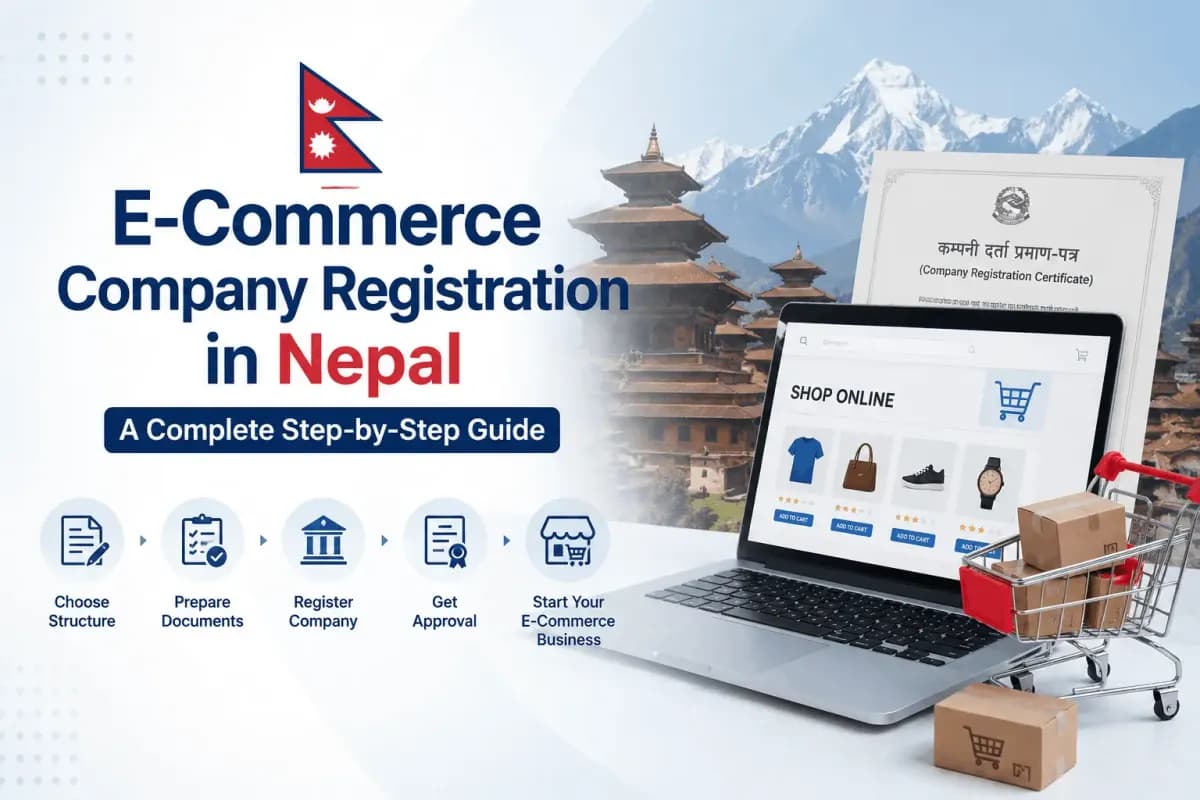
Nepal's online shopping world is growing really fast. More people are buying things online every single day. Young people, small business owners, and big companies are all moving their businesses to the internet. But now, the government has said clearly: if you want to sell online in Nepal, you have to follow the rules.
In 2025, Nepal introduced its very first law made specially for e-commerce businesses. It is called the E-Commerce Act, 2025 (2081). This law came into effect on 16th March, 2025. Since then, every person or company selling things online in Nepal must be registered and listed under this law.
If you have not done this yet, you could face a fine of up to NPR 1,00,000. That is why this guide is so important.
At Joomni, we help businesses and individuals in Nepal understand complex legal processes in a simple way. In this article, we will walk you through everything you need to know about e-commerce company registration in Nepal, what the law says, what steps you need to follow, what documents you need, and what happens if you do not comply.
Why Nepal's E-Commerce Market Is Growing So Fast
Before we get into the legal part, let us understand why this matters so much.
Nepal's e-commerce market generated around US$889 million in revenue in 2024. That is a massive number, and it grew by 20 to 25 percent compared to the year before. The market is expected to reach US$1.95 billion by 2030, growing at a rate of about 7 percent every year.
Almost 60% of Nepalis now have internet access. Over 60% of Nepal's total population is under 30 years old, and most of them are comfortable shopping online. They use platforms like Daraz, Sastodeal, Thulo, HamroBazar, and many social media pages to buy and sell.
Here is the surprising part: most of this selling was happening without any official registration. Thousands of sellers were using Facebook, Instagram, and TikTok to sell products without any legal approval. That is exactly why the government introduced the E-Commerce Act 2025, to bring all of this activity under a proper legal system.
As of July 2026, only 950 e-commerce businesses had officially registered under the new law, even though the government expected hundreds more. This means there is a huge gap. If you have an online business in Nepal and you are not registered yet, now is the time to act.
What Laws Govern E-Commerce Businesses in Nepal?
Two main laws currently govern how e-commerce businesses are set up and operated in Nepal.
The Companies Act, 2006 (2063) is the law that covers how any company in Nepal is formed and registered. It does not matter whether your business is online or offline. You have to register your company under this Act first.
The E-Commerce Act, 2025 (2081) is the newer and more specific law. This law deals with everything that is unique to online businesses, covering listing requirements, consumer rights, digital contracts, return and refund rules, data privacy, and penalties.
Both laws work together. You cannot skip one and follow the other.
Which Businesses Does the E-Commerce Act Apply To?
This is a question many people have, so let us be very clear.
The E-Commerce Act 2025 applies to anyone who buys or sells goods and services through digital means within Nepal. It does not matter where you are physically sitting. If you are selling to customers in Nepal using the internet, this law applies to you.
The Act covers businesses that operate through websites, mobile applications, software, the internet and intranet, and even social media marketplaces like Facebook, Instagram, and TikTok shops.
The law defines an "Electronic Platform" as any system that is designed to conduct transactions through the collection, transmission, or storage of information using computers, mobile devices, or similar electronic equipment.
Here is something very important to note: simply promoting your product online is not considered e-commerce under this law. For example, if you just post photos of your products on Facebook to let people know about them but you do not actually take orders or payments through that platform, you may not be covered. But the moment you start taking orders, payments, or completing sales through any digital platform, you fall under this Act.
The law has a very wide definition of e-commerce, which means even small home-based sellers, individual resellers, and new startup platforms are all covered.
Who Controls E-Commerce Businesses in Nepal?
Two government authorities handle everything related to e-commerce registration and compliance in Nepal.
The Office of Company Registrar (OCR) is where you go first. This office is responsible for officially registering your company. Without an OCR registration, your business does not legally exist.
The Department of Commerce, Supplies, and Consumer Protection is the second authority. After you set up your company and your online platform, you need to get listed with this Department. They monitor online businesses and make sure they are following the rules of the E-Commerce Act.
Think of it this way: the OCR gives you your company's birth certificate. The Department gives you your permission to operate as an online seller.
Step-by-Step Process for E-Commerce Company Registration in Nepal
Now let us go through the actual process. There are five main steps you need to complete. The whole process from start to finish takes about 27 to 35 days.
Step 1: Register Your Company at the OCR
The first thing you need to do is register your company with the Office of the Company Registrar. You can do this online through the OCR's digital portal.
To register, you need to choose a unique company name and check if it is available on the OCR portal. Then you need to prepare two important documents called the Memorandum of Association (MOA) and the Articles of Association (AOA). The MOA explains what your company will do, and the AOA explains how it will be managed. You also need to submit copies of citizenship certificates or passports of all shareholders and directors, along with a lease agreement or property ownership document for your company's registered address.
This step alone usually takes about 7 to 10 working days after you submit everything correctly.
Most private limited companies in Nepal need a minimum paid-up capital of NPR 1,00,000 to register.
Step 2: Register at Your Local Ward Office
After you receive your company registration certificate from the OCR, you need to visit the local ward office in the area where your business is located. This is a simple process that confirms your business in the local government's records.
This step is required by law and takes just a few working days to complete.
Step 3: Get Tax Registration from the Inland Revenue Office
Every business in Nepal, whether online or offline, must register for a PAN (Permanent Account Number). If your annual turnover crosses a certain limit, you will also need VAT registration.
You can apply for your PAN online through the Inland Revenue Office's taxpayer portal. You will need your company registration certificate, your MOA and AOA, and the personal details of the company directors.
The PAN certificate is essential for opening a business bank account, filing taxes, and completing many other official activities.
Step 4: Set Up Your Electronic Platform
Before you can start selling, you need to have your online platform ready. This could be a website, a mobile app, or a properly managed social media business page.
Under the E-Commerce Act, your platform must clearly display several important pieces of information. It needs to show your business registration certificate, PAN certificate, contact details and customer care information, the type of e-commerce you are doing, any applicable licenses, and a grievance handling unit so customers know how to complain if something goes wrong.
This is not optional. Any change in your business details must be updated on the platform within 48 hours of the change.
Step 5: Get Listed with the Department of Commerce
This is the final and most critical step under the new E-Commerce Act. Once your platform is ready, you must apply for listing in the digital business portal maintained by the Department of Commerce, Supplies, and Consumer Protection.
The Department must issue you a listing number within 7 days of receiving your complete application.
If you skip this step or do not apply, you will be operating illegally and can face a penalty of NPR 20,000 to NPR 1,00,000.
The Five Parties in an E-Commerce Transaction and Their Duties
One of the most important parts of the E-Commerce Act 2025 is that it identifies five different parties involved in any online transaction and gives specific duties to each one. This helps everyone understand who is responsible for what.
Buyers are the people who purchase products or services online. They must follow the terms of their purchase agreement, must not act in harmful or disruptive ways, and should check if what they received matches what was described. If there is a problem, they should report it quickly.
Sellers are the individuals or businesses that list and sell their products online. Before they can list anything on a platform, they must sign a written or electronic agreement with that platform. They must provide their business registration proof, PAN or VAT information, and contact details. They must deliver goods on time. They are not allowed to post fake reviews, pretend to be buyers, or engage in unfair business practices.
Intermediary Businesses are online marketplaces like Daraz or Thulo that host other sellers on their platform. They must display accurate information, maintain transaction records according to tax laws, and enter into agreements with each seller before listing their goods. They cannot show favoritism to certain sellers without disclosing it clearly to buyers.
List-Based Businesses are platforms that directly list and sell their own products. They must publish all legally required notices, avoid false advertising, and honor all warranties and guarantees. They take direct responsibility for any claims their platform makes about a product's authenticity.
Courier Services are the businesses that physically deliver orders to customers. Under the Act, they must deliver goods exactly as agreed, to the right person, at the right place, and at the right time. This responsibility applies regardless of any other agreements they may have with sellers or platforms.
This division of duties is very helpful because it makes it clear that if something goes wrong, there is always someone responsible. Platforms cannot simply say it is the seller's problem and walk away.
Important Compliance Rules Your E-Commerce Business Must Follow
Registering your business is just the beginning. Once you are up and running, you need to continuously follow the compliance requirements of the E-Commerce Act. Here are the key rules every e-commerce business in Nepal must follow.
Keep Your Platform Information Updated at All Times
Your platform must always show your business registration certificate, PAN certificate, contact information, customer care details, and the type of e-commerce you are doing. Any change you make to your business, whether it is a new address, a new phone number, or a new owner, must be updated on your platform within 48 hours.
Follow the Return and Refund Policy Strictly
This is a very important rule for customers. If a buyer receives a product that does not match the description you gave, they have the unconditional right to return it, as long as it is unused and undamaged.
You must accept the return and give a full refund including all taxes paid. You cannot attach any conditions to this. The only exception is if the buyer voluntarily agrees to an exchange instead of a refund.
This rule protects customers and makes sure online sellers are honest in how they describe their products.
Protect Your Customers' Personal Data
If your platform collects any personal information from your customers, such as their name, address, phone number, or payment details, you are legally responsible for protecting that data.
You can only use or share customer data as the law permits. Your customers must always be able to access their own information, update it, or ask you to remove it from your system.
Set Up a Proper Customer Complaint System
Every e-commerce business in Nepal must have a customer complaint system. This system can be online, written, or even in-person. But it must be accessible to your customers at all times.
If a customer makes a complaint, you must acknowledge it quickly, investigate it properly, and resolve it within 15 days. The Consumer Protection Act rules also apply to all of your online sales, covering things like product quality, labeling, pricing, and consumer rights.
Electronic Contracts Are Now Legally Valid in Nepal
This is a really important update that many people do not know about yet.
Section 7 of the E-Commerce Act 2025 officially confirms that electronic contracts are legally valid and enforceable in Nepal. This means that any agreement you make digitally with a buyer, whether it involves delivery terms, cancellation policy, return rules, or warranties, is a real and binding contract.
Even a "click-to-accept" agreement, where a user clicks "I Agree" on your website, counts as a legal agreement. This is similar to how it works in countries like the United States, India, and the United Kingdom.
This is great news for online businesses because it creates trust. It means you can run your business digitally without needing paper signatures for everything, and your agreements with customers are fully protected by law.
What Are the Penalties for Breaking the E-Commerce Rules?
The E-Commerce Act is not just a set of suggestions. It is the law, and there are real penalties for breaking it.
For common violations like operating without listing, failing to show required product information, or not following intermediary obligations, fines range from NPR 20,000 to NPR 1,00,000. You can appeal these fines to the Director General within 7 days of receiving the penalty.
For more serious violations like unfair trade practices, false advertising, or serious business malpractice, the penalties are much heavier. These include fines of NPR 40,000 to NPR 5,00,000, imprisonment of 6 months to 3 years, or both.
One thing that surprises many platform owners is that e-commerce platforms are held responsible for complaints about goods or services sold on their platform, even if they did not sell the item themselves. This means if you run a marketplace, you cannot ignore a consumer complaint just because a third-party seller listed the product.
All e-commerce cases are heard in Nepal's newly established Consumer Court, and the Government of Nepal represents public interests in these cases.
What the E-Commerce Act Means for Nepal's Digital Market
Nepal's digital commerce market is growing at an extraordinary pace. Digital commerce transaction value is expected to grow at 28.6% annually and reach nearly US$3.94 billion by 2029. There are already more than 10,000 registered e-commerce websites in Nepal, and this number is rising every month.
The introduction of the E-Commerce Act 2025 is a very significant step. It means Nepal is moving from an unregulated digital marketplace to a structured, law-governed system. This is good for serious businesses because it levels the playing field and builds consumer trust.
Major platforms like Daraz, Sastodeal, HamroBazar, and Thulo already have strong operations in Nepal. But the real opportunity lies with small and medium businesses that are now formalizing their online presence. WooCommerce alone hosts over 2,400 online stores in Nepal, and most of them are small businesses that need clear guidance on how to comply with the new rules.
The biggest challenge right now is that most sellers do not fully understand what the law requires. That is exactly where Joomni can help.
How Joomni Can Help You With E-Commerce Registration in Nepal
At Joomni, we specialize in helping businesses in Nepal navigate the legal and regulatory landscape without the confusion, the wasted time, and the risk of costly mistakes.
Whether you are starting a brand new online business or you already have an existing store that needs to be properly registered, our team can handle the entire process for you, from OCR registration all the way to Department listing and ongoing compliance support.
Our services include company name availability check and reservation, drafting of MOA and AOA, OCR registration, PAN and VAT registration, ward office registration, e-commerce platform compliance review, Department listing application, and post-registration compliance support.
You focus on growing your business. We take care of the legal side.
Get in touch with Joomni today and let us make your e-commerce registration in Nepal smooth, fast, and fully legal.
Frequently Asked Questions (FAQs)
Q1. Does every online seller in Nepal need to register under the E-Commerce Act 2025?
Yes. The E-Commerce Act 2025 applies to anyone who sells goods or services through a digital platform to customers in Nepal. This includes small home-based sellers, social media sellers, and large e-commerce platforms. The only exception is if you are merely promoting products online without actually taking orders or completing transactions digitally.
Q2. How long does the entire e-commerce company registration process take in Nepal?
The full process takes approximately 27 to 35 days. Company registration at the OCR typically takes 7 to 10 working days. After that, the Department of Commerce must issue your listing number within 7 days of receiving your complete application. The remaining time covers ward office registration, tax registration, and platform setup.
Q3. What is the fine for running an e-commerce business in Nepal without registering?
If you operate an e-commerce business without getting listed with the Department of Commerce, Supplies, and Consumer Protection, you can be fined between NPR 20,000 and NPR 1,00,000. More serious violations can lead to fines up to NPR 5,00,000 and even imprisonment.
Q4. Do social media sellers on Facebook, TikTok, or Instagram also need to register?
Yes. The E-Commerce Act specifically covers sellers who use social media marketplaces to sell products and services. If you take orders and complete sales through Facebook, Instagram, or TikTok in Nepal, you are legally required to register and get listed with the Department.
Q5. What information must an e-commerce platform display to customers?
Your platform must display your business registration certificate, PAN certificate, contact details, customer care information, the type of e-commerce you are operating, applicable licenses, and information about your grievance handling unit. Any changes to this information must be updated within 48 hours.
Q6. Can a foreign e-commerce company sell to customers in Nepal without registering?
No. Under the E-Commerce Act 2025, even foreign e-commerce companies are required to comply. If an international company sells goods to customers in Nepal, it must establish a local office or appoint an official representative in Nepal. As of mid-2026, no major international platform had registered, which technically makes their sales to Nepali customers non-compliant under the new law.
Q7. What is the difference between OCR registration and Department listing?
OCR registration is the process of officially incorporating your company in Nepal under the Companies Act. It gives your business a legal identity. Department listing is the e-commerce-specific requirement under the E-Commerce Act 2025 where you register your online business with the Department of Commerce, Supplies, and Consumer Protection. You need both. One without the other is not enough.
Q8. Are click-to-accept agreements and digital contracts legally valid in Nepal?
Yes. Section 7 of the E-Commerce Act 2025 formally recognizes electronic contracts as legally valid and enforceable in Nepal. This includes click-to-accept agreements where a user clicks "I Agree" on your website or app. As long as proper notice and consent are given, these agreements are binding.
Q9. What rights do buyers have under the E-Commerce Act 2025?
Buyers in Nepal have the unconditional right to return a product if it does not match the description given by the seller, as long as it is unused and undamaged. They are entitled to a full refund including taxes paid. Sellers cannot attach conditions to the return unless the buyer voluntarily agrees to an exchange. Buyers also have the right to file complaints through an accessible grievance system and receive a resolution within 15 days.
Q10. How can Joomni help me register my e-commerce business in Nepal?
Joomni provides end-to-end support for e-commerce company registration in Nepal. This includes company name reservation, drafting of MOA and AOA, OCR registration, PAN and VAT registration, ward office registration, Department of Commerce listing, and ongoing compliance advice. Our goal is to make the entire process simple, fast, and worry-free for you.
Disclaimer: This article is published by Joomni for informational purposes only. It does not constitute legal advice. For advice specific to your business situation, please consult a qualified legal professional or contact the Joomni team directly.
Written by
Admin