Are you a business owner in Nepal looking to build a website but not sure where to start? You are not alone. Thousands of shop owners, freelancers, clinic operators, restaurant owners, and NGO managers across Nepal want an online presence but feel stuck because they think they need to hire a developer or learn coding first.
The truth is, you do not need either.
A good website builder in Nepal today gives you everything you need to put your business online, on your own, in your own language, at a price that makes sense. No developer required. No coding knowledge. No waiting weeks for someone else to finish the job.
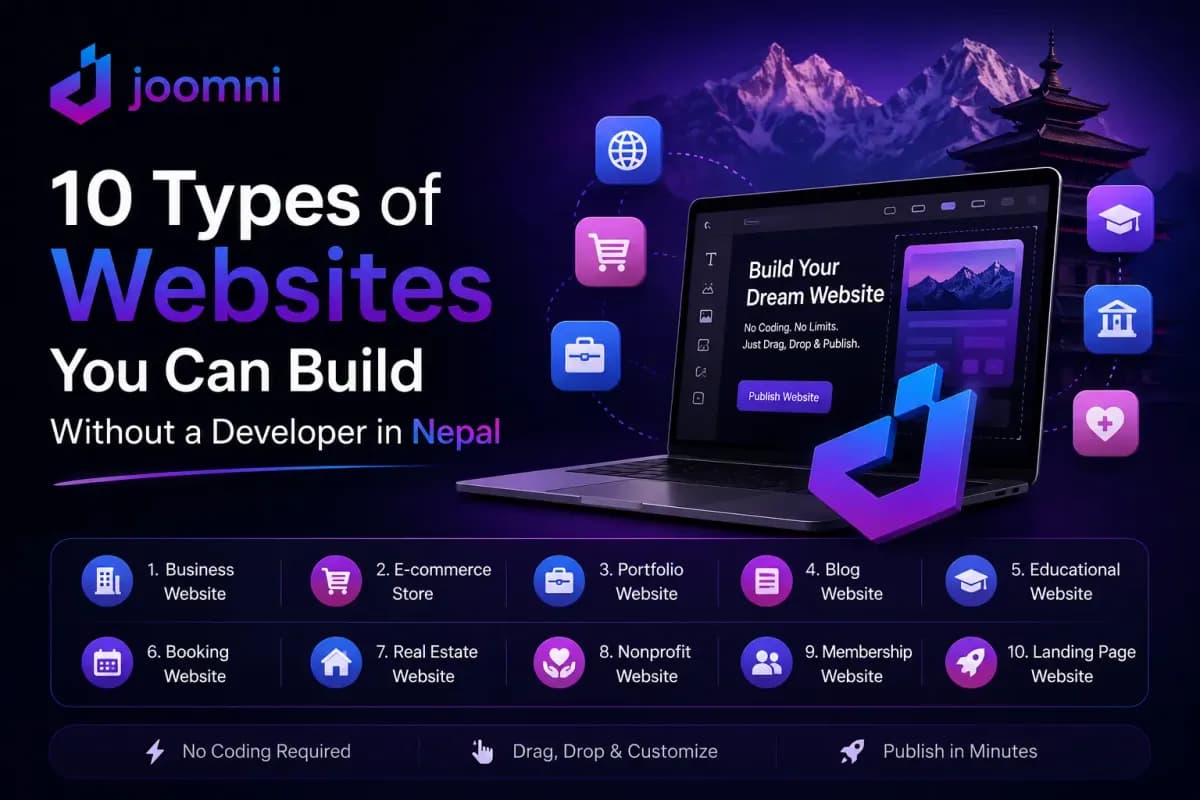
In this guide, we walk through 10 different types of websites that anyone in Nepal can build themselves. Whether you run a shop in New Road, a clinic in Lalitpur, a restaurant in Thamel, or you are a freelance photographer chasing international clients, there is a website type here that fits.
Let us start with the basics.
What's in this guide
- Why most Nepali businesses still have no website
- What is a website builder?
- Type 1: Business website
- Type 2: Online store
- Type 3: Portfolio website
- Type 4: Restaurant or cafe website
- Type 5: Appointment booking website
- Type 6: Blog or personal website
- Type 7: NGO or non-profit website
- Type 8: Landing page
- Type 9: Educational or course website
- Type 10: Service business website
- How to pick the right type
- Frequently asked questions
Why Most Nepali Businesses Still Do Not Have a Website
A large majority of registered businesses in Nepal have no proper website [VERIFY: the previous draft claimed "less than 5% of registered businesses" and "more than 250,000 registered businesses, over 237,000 with no website." Both figures were unsourced. Either find a citation, ideally from the Office of the Company Registrar or a named industry report, or keep this qualitative].
So why is the number so high?
The cost myth. Hiring a web developer in Nepal has traditionally cost tens of thousands of rupees for a basic website. For most small business owners, that money simply is not available, so the website gets pushed to "someday." Our honest breakdown of what a website costs in Nepal covers what the real range is now.
The coding myth. Many people believe making a website requires knowing how to code. Fifteen years ago that was mostly true. Today it is completely false. Modern builders let you create a website by clicking and typing, the same way you use Microsoft Word or Canva.
The Facebook trap. A lot of Nepali businesses use a Facebook page as their website. Facebook is a great tool for reaching customers, but it is not the same as owning a website. You do not control your page, Facebook does. It can be suspended, your reach can be cut, and customers cannot easily find you on Google from a Facebook page alone.
The time excuse. "I will build a website later when things are less busy." With today's builders, a basic website can be live in a few hours, not weeks.
The barriers that used to exist do not exist anymore. No-code and AI-powered platforms have made the process faster and simpler than most business owners realise.
What Is a Website Builder and How Does It Work?
A website builder is an online tool that lets you create a website without writing any code. You log in, choose a design template, add your text and photos, and publish. For most people, that is the whole process.
Think of it like Canva for websites. You drag elements around, type your content, and change colours and fonts with simple clicks.
The best builders now include AI features. You describe your business in plain language and the AI designs and builds a page for you. You review it, adjust, and publish. Our guide to AI website builders in Nepal covers how that works in practice.
Now let us get into the 10 types.
Type 1: Business Website
Best for: Shops, offices, trading companies, import-export businesses, law firms, accounting firms, consulting companies
Why you need one. A business website is your company's permanent home on the internet. When someone searches your business name on Google, your website is what should appear. It tells people who you are, what you do, where you are, and how to reach you.
A proper business website usually includes a home page, an about page, your products or services, a contact page, and sometimes a team or careers section.
The Nepal reality. Right now, when most Nepali businesses are searched on Google, the result is either nothing or a Facebook page. Neither makes a good impression. A potential client finding no website will often move on to a competitor who has one.
Think about it from the customer's side. Looking for an accounting firm in Kathmandu and finding two options, one with a professional website showing services, team, and contact details, and one with only a Facebook page. Which feels more trustworthy?
What it gives you. A professional presence that works on mobile and desktop. A page that shows up in Google searches. Somewhere customers can learn about you at any hour without calling. A contact form that captures leads while you sleep.
Pro tip. Add your Google Maps location and business hours. Combined with a properly optimised Google Business Profile, these are what put you in front of people searching "near me." Our guide to local SEO and ranking on Google Maps in Nepal walks through the whole setup.
Type 2: Online Store (Ecommerce Website)
Best for: Clothing brands, handicraft sellers, food product businesses, electronics shops, cosmetics brands, book sellers, exporters, grocery businesses
Why you need one. If you sell any kind of product, an online store lets you sell 24 hours a day, to anyone in Nepal or anywhere in the world.
The Nepal reality. Many Nepali sellers rely on Daraz or Sastodeal. Those marketplaces bring customers, but they take a commission on every sale, control how your products appear, and technically own the customer relationship. You cannot contact buyers directly, build loyalty, or grow your own brand.
Your own store changes all of this. Your customers are yours. You keep the profit. Your brand is front and centre. We made the full case in Daraz vs your own website, and our Daraz commission calculator shows what the marketplace actually costs you each month.
What it gives you. A branded shop where customers browse, add to cart, and pay using eSewa, Khalti, Fonepay, Cash on Delivery, or international methods. Order tracking. Inventory that updates automatically. See online store features for the full list.
Pro tip. Nepali buyers heavily prefer Cash on Delivery. Make sure COD is enabled. Also invest time in your product descriptions, because they are what bring search traffic to individual products.
Type 3: Portfolio Website
Best for: Photographers, graphic designers, architects, fashion designers, filmmakers, illustrators, video editors, content creators
Why you need one. Your portfolio is your most powerful business card. It is the first thing potential clients see when deciding whether to hire you.
The Nepal reality. Nepal has a growing community of talented creative professionals doing world-class work. Most have no portfolio website. Their work lives on Instagram or inside WhatsApp messages, which means international clients who could pay far higher rates simply cannot find them.
A portfolio website puts you on the map globally. Upwork, Fiverr, and LinkedIn all direct potential clients to your personal site. Without one, you look less professional than freelancers competing for the same work.
What it gives you. A clean, visual showcase organised to tell your story. A professional bio. A contact form. Client testimonials. SEO so people searching "photographer in Kathmandu" or "graphic designer Nepal" can find you.
Pro tip. Include 5 to 8 of your absolute best projects rather than everything you have ever done. Quality over quantity. Each project needs a short description of what you did, who the client was, and what the result was.
Type 4: Restaurant or Cafe Website
Best for: Restaurants, cafes, bakeries, tea houses, bars, cloud kitchens, food delivery businesses
Why you need one. When someone hears about your restaurant, the first thing they do is look it up. If they cannot find a proper website, many simply choose somewhere else.
The Nepal reality. Kathmandu, Pokhara, and other cities have hundreds of excellent restaurants. The vast majority have no website. Menus are not online. Locations are hard to find. Reservations happen only by phone. For tourists especially this is a real barrier, because they cannot pre-plan.
What it gives you. Your full menu with photos and prices. Opening hours and location on a map. Online ordering with eSewa payment. A table reservation system. A gallery showing your ambiance and signature dishes. Our restaurant solution covers the setup, and our deeper guide on why your restaurant needs a website in Nepal covers the business case including delivery app commissions.
Pro tip. Add high-quality photos of your best dishes. A phone camera in good light is enough to start. Restaurants with real food photography consistently see more online orders than those without.
Type 5: Appointment Booking Website
Best for: Clinics, doctors, dentists, physiotherapists, beauty salons, spas, nail studios, gyms, personal trainers, tutors, lawyers, consultants
Why you need one. If your business runs on appointments, a booking website saves hours every week on the phone and cuts no-shows through automatic reminders.
The Nepal reality. Most clinics, salons, and service businesses in Nepal still book by phone or WhatsApp. This creates problems on both sides. Customers must call during working hours. Staff spend time on the phone instead of with clients. Appointments get forgotten because reminders are manual. And after-hours bookings are simply lost.
A booking website fixes all of this at once. Clients book any time of day or night, see real availability, pay a deposit to confirm, and get an automatic reminder the day before. You wake up to a full calendar without a single phone call.
What it gives you. A public booking page showing available slots. Calendar sync so you are never double-booked. Automatic SMS and email reminders. Deposit or full payment collection through eSewa or Khalti. Multiple staff schedules if you have a team.
Pro tip. If you run a clinic or salon in Kathmandu, consider being the first in your area to offer online booking. It is a genuine competitive advantage, and customers notice not having to call.
Type 6: Blog or Personal Website
Best for: Writers, journalists, educators, financial advisors, life coaches, travel bloggers, food bloggers, tech writers, Nepali content creators
Why you need one. A blog is one of the most effective long-term tools for building an audience, establishing expertise, and attracting clients without paid advertising.
The Nepal reality. The Nepali online content space is growing rapidly in both Nepali and English. Writers and educators with their own blog build audiences that social media alone cannot, because a blog post can be found on Google years after publication while a Facebook post disappears within days.
What it gives you. A publishing platform you fully own. Posts organised by topic. A newsletter signup. SEO that brings readers from Google over time. A professional base that demonstrates expertise to clients, employers, or partners.
Pro tip. Write about topics people in Nepal actively search for. "How to save money in Nepal," "best trekking routes for beginners," "how to start a business in Nepal." Practical, helpful posts bring consistent traffic month after month. Our content management documentation covers the publishing side, and the complete SEO guide covers getting found.
Type 7: NGO or Non-Profit Website
Best for: NGOs, charities, community organizations, social enterprises, foundations, advocacy groups, international development organizations
Why you need one. A professional website is one of the most important tools any non-profit can have. It is how donors find you, how volunteers connect, how partners evaluate you, and how beneficiaries learn about your programs.
The Nepal reality. Nepal has thousands of registered NGOs doing incredible work with no way to share it online. Without a website, even well-funded organizations struggle to attract international donors or partnerships, because they cannot be found or evaluated easily.
What it gives you. A home for your mission and impact stories. Project pages showing what you have accomplished. A team page that builds trust. Annual reports available for download. A donation button connected to eSewa, Khalti, or international payment methods. A volunteer registration form. A news section.
Pro tip. Put real impact numbers prominently on your home page. "We have planted 50,000 trees" or "We have supported 2,000 students" is far more powerful than a paragraph about your mission. Numbers create instant credibility.
Type 8: Landing Page
Best for: Product launches, seasonal sales campaigns, event promotions, pre-launch waitlists, awareness campaigns, lead generation
Why you need one. A landing page is a single focused page with one goal. No navigation menu. No distractions. Its entire purpose is to get the visitor to do one specific thing: sign up, buy, register, or contact you.
The Nepal reality. Every time a Nepali business runs a Dashain sale, a product launch, or a promotion, they typically just post on Facebook. That post disappears from feeds within hours. A landing page stays live for the whole campaign, ranks on Google, and gives your promotion a permanent, professional home.
What it gives you. A focused page that converts better than a homepage. A specific URL to share on social media, SMS, and WhatsApp. Somewhere to collect emails and phone numbers. A page that can rank for your specific promotion.
Pro tip. Keep it focused on a single action. If you want calls, put your phone number everywhere and remove every other link. If you want sales, put the buy button front and centre. Every distraction reduces conversions. Once you are collecting contacts, automated email campaigns turn those signups into customers.
Type 9: Educational or Course Website
Best for: Tutors, training centres, language schools, test preparation coaches, skill training businesses, online course creators, schools
Why you need one. Online education in Nepal is growing fast. Students and professionals actively look for quality tutors and training programs online. A website gives your educational business a professional presence that builds trust and helps students find you.
The Nepal reality. Most tutors and training centres advertise through flyers, word of mouth, or Facebook groups. A dedicated website puts you ahead of every competitor still doing that. It also lets students outside Kathmandu, or Nepali students abroad, find you and sign up for online sessions.
What it gives you. A page per course with description, schedule, fees, and enrollment form. Student testimonials. Photos or video of you teaching. A calendar of upcoming batches. Online fee collection through eSewa or Khalti before students even arrive.
Pro tip. Add a short video introducing your teaching style and experience. People buy from people they trust, and a 60-second video does more for trust than paragraphs of text.
Type 10: Service Business Website
Best for: Electricians, plumbers, painters, cleaning services, pest control, event planners, wedding photographers, tour operators, driving schools, vehicle rental, security agencies
Why you need one. If you provide a service to homes or businesses, a website helps new customers find you, specifically the ones who do not already know you through a referral.
The Nepal reality. Service businesses in Nepal grow almost entirely through word of mouth, which means growth is capped by your existing network. A website breaks that ceiling. When someone searches "plumber in Lalitpur" or "wedding photographer Pokhara," you want to be the first result. Without a website you cannot appear at all.
What it gives you. A page explaining exactly what you offer, where you serve, and what you charge. Before and after photos. Customer reviews. A contact form or phone number. A quote request form that collects leads while you are on a job.
Pro tip. Ask your 5 happiest customers for a short written review and add it to your site. Real feedback is the single most powerful thing on a service business website. Our full guide to generating leads online for a service business in Nepal covers the ten channels that actually work here.
How to Pick the Right Website Type for Your Business
I sell physical or digital products Online Store
I take appointments or bookings Appointment Booking Website
I am a creative professional or freelancer Portfolio Website
I run a restaurant, cafe, or food business Restaurant Website
I have a shop, office, or service company Business Website
I write, teach, or share knowledge Blog or Educational Website
I run an NGO or non-profit NGO Website
I am running a campaign or product launch Landing Page
I provide home or business services Service Business Website
Some businesses need something more specific again. If you run a hotel or guesthouse or work in real estate, those have their own requirements around availability, listings, and enquiries.
And remember, these types are not mutually exclusive. A restaurant can have online ordering and a booking system. A photographer can have a portfolio and an online store for selling prints. Start with one and add features as you grow.
Choosing a Platform Built for Nepal
International builders like Wix and Squarespace work, but they carry real limitations for Nepal-based businesses: no native support for eSewa, Khalti, or Fonepay, pricing in US dollars, and templates designed for Western markets [VERIFY: confirm the current state of Wix and Squarespace's Nepali language and payment support before republishing, as both platforms add regional features regularly].
We have honest, detailed comparisons for the Nepali market covering Wix, Shopify, and WordPress and WooCommerce.
Joomni is built specifically for Nepal, with all major local payment gateways, AI that builds pages from plain-language instructions in Nepali and English, and built-in booking, ecommerce, SEO, and point of sale in one platform rather than separate subscriptions [VERIFY: confirm every feature and pricing claim in this section with your product team. See editor's notes]. Current plans are on the pricing page.
Frequently Asked Questions
Do I really need a website if I already have a Facebook page?
Yes. A Facebook page and a website serve different purposes. Facebook is good for posting updates and engaging followers, but it does not replace a website. Your page can be suspended or restricted at any time. It does not show up well on Google. And customers cannot find your prices, location, and services on a Facebook page the way they can on a website. A website is something you own permanently.
How long does it take to build a website in Nepal?
Most people publish a first website within a few hours. With AI features, large sections build automatically, which cuts the time considerably. Simple sites like portfolios or landing pages can be done in under an hour. Our first launch guide walks through the steps.
Do I need to know English or coding to use a website builder?
No to both. Modern builders are designed so anyone who can type and use a smartphone can build a website. No coding is required at any step, and Nepali language content is fully supported. If you would rather read in Nepali, see our website kasari banaune guide.
How much does a website cost in Nepal without a developer?
Far less than hiring a developer, and with no extra charge every time you want to change something. Current plans are on our pricing page, and our full cost breakdown compares every option including hiring a freelancer or agency.
Will my website appear on Google search results?
It can, but not automatically just by existing. A good platform handles the technical foundations, meta titles, descriptions, sitemaps, and page speed, so you are starting from a solid base. Ranking still requires the right keywords and content. See our SEO settings documentation and the complete SEO guide.
Can I update my website myself after it is live?
Yes, completely. Log in any time and change text, update prices, add products, swap photos, or add pages, with no coding or developer help.
What if I already have a domain name or an existing website?
If you own a domain, you can connect it to your new site. If you have an existing website you want to move, support can help with migration.
Is my website safe and secure?
Every site should come with an SSL certificate, the padlock in your browser address bar, plus regular backups and a way to restore if something breaks. Payment information should be handled through PCI-DSS compliant flows. Our security page covers what is included.
Can I build a website in the Nepali language?
Yes. You can write your pages in Nepali, and AI tools understand Nepali instructions.
What happens if I need help while building?
Support is available in Nepali, along with tutorial documentation covering the platform. You are not on your own. See the help centre or contact the team.
Final Thoughts
Having a website in 2026 is not a luxury for businesses in Nepal. It is the foundation of being found, being trusted, and growing beyond your current network.
The 10 types in this guide cover almost every business situation, from a small handicraft seller in Bhaktapur to a consulting firm in Baneshwor, from a beauty salon in Pokhara to a tutoring centre in Butwal.
The cost barrier is gone. The coding barrier is gone. The time barrier is nearly gone too, with AI tools that build large parts of your site automatically.
The only thing left is to start.
You can see what other Nepali businesses have built in our customer stories.
Ready to build? Start with Joomni or compare plans. Your customers are already searching for you online. Make sure they can find you.
Written by
Admin