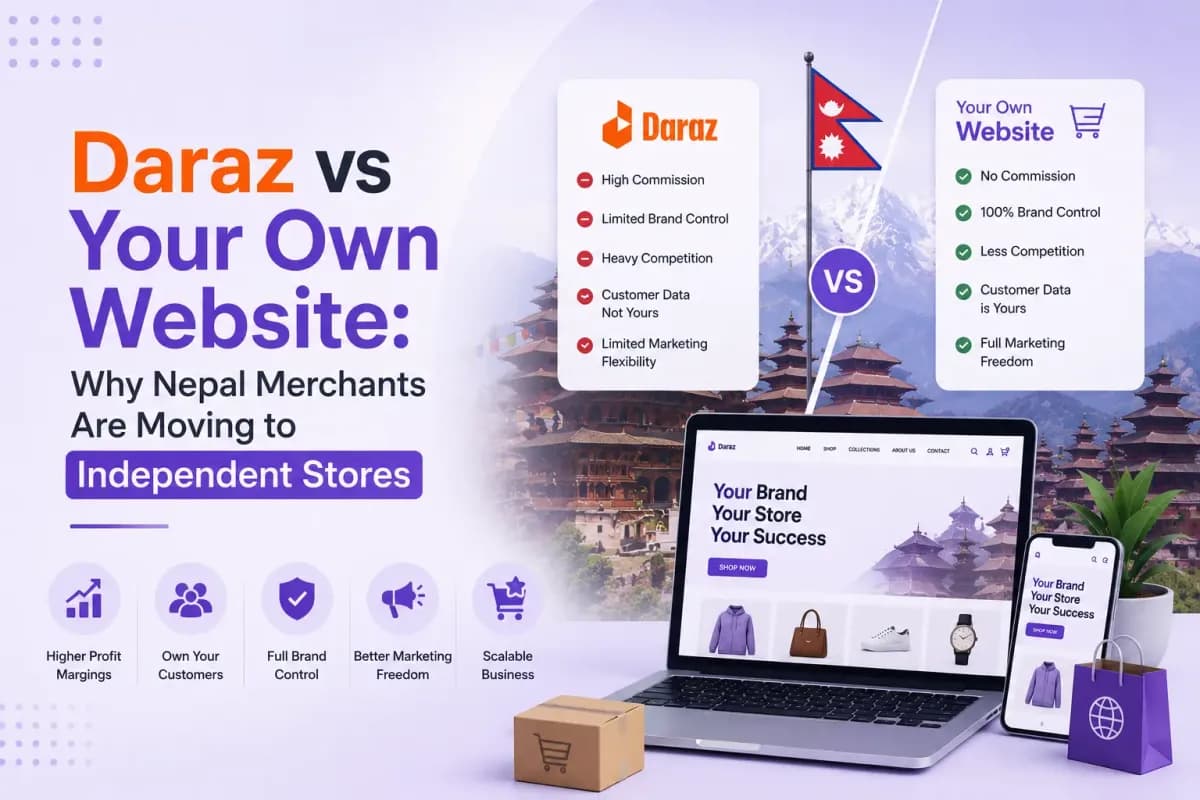
Imagine you run a small shop in Kathmandu selling handmade woolen scarves. You started on Daraz a few years back, excited about reaching customers across Nepal without leaving your store. The first few months felt promising. Orders trickled in, your seller rating climbed, and you thought you had cracked the code of online selling.
Then reality set in. Those commissions started eating into your profits month after month. You were competing with hundreds of nearly identical listings. Customers were buying from you but you had absolutely no way to reach them again. And no matter how good your product was, your brand looked exactly like everyone else's on the platform.
Sound familiar? You are not alone.
This is the daily reality for thousands of Nepali sellers right now. Across Kathmandu, Pokhara, Biratnagar, Butwal, and everywhere in between, merchants who once saw Daraz as a golden ticket are quietly rethinking their strategy. Many are making a deliberate move toward owning their own independent online stores.
Nepal's ecommerce market continues to expand [VERIFY: see editor's note. The previous "US$1.38 billion in 2025, growing at roughly 28% annually" figure appears to conflate two different Statista datasets and conflicts with other sources. Replace with a sourced figure or keep this sentence qualitative]. Whatever the exact number, the platform you choose today will directly shape how much of that growth you actually keep.
In this post, we break down the top 10 reasons behind this shift, give you an honest comparison of your real options, and show you what the move actually involves.
What's in this guide
- 1. Escaping commission fees that kill your margins
- 2. Full control over your brand identity
- 3. Cutting through the competition
- 4. Delayed payments and hidden charges
- 5. Who owns your customer data?
- 6. Protecting your margins long-term
- 7. Building the store your customers need
- 8. Real, lasting customer relationships
- 9. Protection from platform instability
- 10. Adopting new trends before competitors
- Should you leave Daraz completely?
- Frequently asked questions
1. Escaping Commission Fees That Kill Your Margins
This is where the frustration almost always begins.
Daraz's commission structure varies by product category, and once you stack a payment handling fee, applicable VAT, and shipping-related deductions on top, a Rs. 1,000 sale can shrink meaningfully before it reaches your account [VERIFY: confirm Daraz Nepal's current commission bands, payment handling fee, and typical total deduction range before republishing specific percentages].
For anyone selling handmade items, food products, or lower-ticket goods with naturally thin margins, this is genuinely punishing. You can be running a busy store, fulfilling dozens of orders a week, and still struggle to make the numbers work.
Work out your own number before deciding anything. Our Daraz commission calculator shows exactly what your category costs you per month, which is a more useful basis for this decision than any general percentage.
Running your own website changes the structure entirely. Payment gateway fees through eSewa, Khalti, or Fonepay are a fixed percentage per transaction with no commission layered on top, and you can model the difference with our payment fee calculator. Over hundreds or thousands of sales a year, that gap compounds into real income.
2. Full Control Over Your Brand Identity
On Daraz, your store is one among thousands. Daraz's branding wraps the entire shopping experience, your product pages follow a standardized template, and there is very little room to express what makes your business different. A buyer sees the Daraz logo, the Daraz layout, and the Daraz checkout. Your brand, your story, your values, they all get swallowed.
Merchants across Nepal describe the same frustration. A Pokhara tea seller with a beautiful product sourced from small farms in the hills cannot convey any of that through a Daraz listing. It looks like every other tea listing on the platform.
With an independent store, you own the entire customer experience from homepage to checkout. You choose the colours, the fonts, the photography, the tone of your descriptions, and how your packaging appears on screen. You can publish your origin story, share behind-the-scenes content, and create a reason for customers to choose you beyond price.
As competition increases, that kind of differentiation stops being a luxury and becomes a survival skill.
3. Cutting Through the Competition
Daraz Nepal hosts thousands of active sellers, and many are selling variations of the same products. Price wars are constant. Visibility depends on your willingness to spend on Daraz's internal advertising, and even then the algorithm can shift and bury your listings without warning.
Larger sellers and official brand stores have advertising budgets most small merchants cannot match. Competing there means either racing to the bottom on price or spending aggressively on ads just to stay visible. Neither builds a healthy business.
An independent store lets you step outside that noise entirely. A handicraft seller from Biratnagar can optimise their site for specific searches like "handmade Nepali crafts online" or "traditional Newari jewelry Nepal" and attract buyers actively looking for exactly that, with no competing listings sitting next to theirs.
This is the part sellers underestimate. Targeted, intent-driven traffic from Google converts far better than passive marketplace browsing, because you are reaching people who already want what you sell. Our complete ecommerce SEO guide covers how to earn that traffic, and if you also serve walk-in customers, ranking for "near me" searches captures the same intent locally.
4. Delayed Payments and Hidden Charges
Cash flow is the lifeblood of any small business, and payout timelines are one of the most consistent complaints from Nepali marketplace sellers. Funds can take days or weeks to clear. Unexpected deductions for returns, failed deliveries, or promotions add another layer of unpredictability. When suppliers expect prompt payment, that delay stalls your ability to grow.
With your own website integrated with local payment gateways like eSewa or Khalti, settlement is far faster and far more visible. You know what is coming in, when, and how much of it is yours, with no surprise deductions buried in a platform statement.
That financial clarity matters more than most sellers realise, especially when you are trying to reinvest quickly.
5. Who Owns Your Customer Data?
This deserves far more attention than it usually gets, and it is arguably the strongest argument in this entire article.
When someone buys from your Daraz storefront, Daraz captures everything: full name, email address, phone number, purchase history, browsing behaviour, payment preferences. All of it belongs to Daraz. What do you get? A shipping address and an order ID. That is the full extent of your relationship with your own buyer.
Think about what that means in practice. You cannot send that customer a personalised offer ahead of Dashain. You cannot tell them when a product they bought is back in stock. You cannot build a loyalty programme, ask for a review, or invite them to follow you. Every marketplace sale is a one-time transaction with a stranger you will never speak to again.
In a market where repeat purchases drive a meaningful share of revenue, that is a serious structural disadvantage.
Your own store changes it completely. You collect emails and phone numbers directly, segment customers by purchase history, and send offers that actually land. Setting up automated email and messaging campaigns once means welcome sequences, restock alerts, and festival offers run without you touching them.
Over time, a well-maintained customer list becomes the most valuable asset your business owns, worth far more than any single season's sales.
6. Protecting Your Margins Long-Term
High marketplace fees create a profit ceiling that is very hard to break through no matter how much volume you move. Some sellers process hundreds of orders a month and barely break even, because the platform takes too large a share of every transaction.
Independent stores flip this over time. After an initial setup investment, your ongoing costs drop considerably. As you build organic search traffic, grow a social following, and expand your email list, your customer acquisition cost falls. You stop paying per sale and start investing in channels that compound.
That is the fundamental shift from a business that merely sustains itself to one that scales. If you want the actual numbers on what setup costs, our breakdown of what an ecommerce website costs in Nepal covers every line item honestly, including the cheap route.
7. Building the Store Your Customers Actually Need
Daraz's platform is rigid by design. Standardised listing templates, limited control over presentation. Want demonstration videos, product bundles, a subscription model for repeat purchases, or custom filtering for your catalogue? Mostly not possible.
Your own website is built around your needs. Add a blog that educates buyers. Create a loyalty points system. Integrate live chat. Build a referral programme that turns happy customers into promoters.
With mobile commerce dominating how Nepali shoppers browse and buy, a properly responsive store tailored to your audience is not optional. Modern no-code and AI-powered builders make this level of customisation possible without hiring a developer or managing infrastructure.
If you also sell in person, connecting your online catalogue to a point-of-sale system keeps stock and prices consistent across both.
8. Building Real, Lasting Customer Relationships
Marketplaces are designed to keep the customer relationship with themselves, not with you. Communication is filtered through the platform. Interactions feel transactional by default. There is very little room to create the human connection that turns a one-time buyer into someone who recommends you.
On your own store you can build that deliberately. Offer direct WhatsApp or Viber support. Publish content customers find genuinely useful. Respond to feedback publicly in a way that builds credibility.
A spice seller from Butwal who shares traditional recipes through a simple blog is not just selling spices. They are building a community of food lovers who trust their expertise. A skincare brand from Kathmandu sending recommendations based on customer skin types is creating loyalty no marketplace discount can replicate.
These are the relationships that generate word-of-mouth and a customer base that grows on its own. You can see how other Nepali businesses have built this in our customer stories.
9. Protection From Platform Instability and Policy Changes
Daraz has faced significant restructuring and operational challenges across its markets in recent years. Policy changes, fee revisions, and operational shifts can arrive with little warning, and sellers who rely entirely on one marketplace have very little power to push back.
Beyond Daraz, the pattern repeats across global ecommerce. Sellers who built everything on a single platform, whether Amazon, Flipkart, or Alibaba, have faced sudden account suspensions, algorithm changes that wiped out traffic overnight, or fee increases that made their model unviable.
This is the same argument that applies to running your entire business through a Facebook page: rented reach is fast to start and expensive to depend on.
Your own website belongs to you. No other company's decisions can shut you down or change your terms overnight. That is genuine business resilience, and it is worth taking seriously.
10. Adopting New Trends Before Your Competitors Do
Nepal's ecommerce landscape is evolving faster than most sellers realise. Social commerce through TikTok and Instagram is growing quickly, particularly among younger urban buyers. AI-powered personalisation is becoming a baseline expectation. Hyperlocal delivery networks are opening possibilities for sellers in smaller cities that did not exist a few years ago.
Marketplaces move relatively slowly on integrating these into the seller experience. They have their own roadmap and priorities, and individual sellers have no influence over them.
Independent stores can adopt new tools immediately. You can link a TikTok shop to your catalogue, implement AI-driven recommendations for returning visitors, and experiment with new formats without waiting for a marketplace to ship a feature.
The next shift is already visible: AI assistants that browse, compare, and buy on a customer's behalf. What that means for Nepali sellers is covered in agentic commerce, and our roundup of AI tools for Nepali online stores covers what you can use today.
Should You Leave Daraz Completely?
Not necessarily, and certainly not all at once.
For sellers newer to ecommerce, Daraz still provides a valuable entry point. The traffic is real, the barrier to listing is low, and it remains a useful place to test whether a product has genuine demand before investing in your own infrastructure.
The smarter long-term approach is to use Daraz as a customer discovery channel while deliberately building your own store as your primary business asset. Run both, but treat your independent website as the actual business and Daraz as a lead source.
Over time, as your email list grows, your Google rankings improve, and your loyal customer base expands, you will naturally find yourself less dependent on the marketplace. The goal is not to abandon Daraz dramatically. It is to gradually outgrow your need for it.
Making the Transition
Moving from a marketplace to an independent store raises practical questions. What platform do you use? How do you handle payments and delivery? How do you get traffic to a website nobody knows about yet?
Joomni is built to answer these for Nepali sellers specifically. It's an AI-powered ecommerce platform with eSewa and Khalti integrated by default, billing in NPR, and no development team or technical background required. Our first launch guide walks through the setup, and plans are here.
For a broader look at how it compares to the alternatives, we have honest breakdowns for Shopify, WordPress and WooCommerce, and Wix in the Nepali market.
The Bottom Line
The question comes down to one distinction: do you want to build a business, or do you want to sell products?
Selling products is fine. Daraz makes it relatively easy, and there is nothing wrong with starting there. But building a business, one with real customer relationships, a brand people trust, healthy margins, and long-term value, requires owning your own platform.
Nepal's ecommerce opportunity is real and still largely open to independent sellers willing to invest in their own infrastructure. The merchants making that investment now, building their stores, growing their lists, and developing their search presence, are the ones who will capture the most value as the market matures.
Your independent store is not a distant goal. The tools are available, Nepal's payment infrastructure is better than ever, and the customers are online and ready to buy.
The only question left is whether you are ready to own what you build.
Nepali ma padhna man cha? Hamro website kasari banaune guide hernuhos.
Frequently Asked Questions
Is it expensive to set up your own ecommerce website in Nepal?
Not anymore. A few years ago, custom development in Nepal ran from tens of thousands of rupees to several lakhs depending on complexity. Modern platforms let you launch a professional store for a fraction of that, often with no large upfront investment. Our full breakdown of what an ecommerce website costs in Nepal covers every option, including the bootstrap route. The commission savings typically cover the setup cost within the first few months of consistent sales.
Can I sell on both Daraz and my own website at the same time?
Absolutely, and many growing Nepali merchants do exactly this, particularly early in the transition. Use Daraz to attract new customers and generate volume while building your independent store as your brand home. Over time, most sellers naturally shift their marketing focus toward their own store, where returns are more predictable and margins are higher.
What payment methods can I offer on my own website in Nepal?
All the major Nepali gateways: eSewa, Khalti, Fonepay, and ConnectIPS. Most platforms also support cash on delivery, which remains preferred by many customers outside Kathmandu. International options can be added if you plan to sell abroad. Unlike Daraz, you control which options appear at checkout and how they are structured. Our payment gateway documentation covers the setup.
What happens to my existing Daraz customers if I move to my own website?
Daraz does not share customer contact information with sellers, so you cannot export or migrate that list. But you can start building your own audience immediately. Include a QR code or card in every Daraz order directing buyers to your website with an exclusive first-purchase discount. Promote your store actively on social media and encourage followers to join your email list. It takes time but is very achievable.
Is it difficult to manage SEO for an independent store in Nepal?
More straightforward than most sellers expect. Using relevant keywords in titles and descriptions, writing clear product pages, and publishing occasional blog content around what your customers search for can generate meaningful organic traffic within three to six months. Platforms with SEO-friendly structure built in mean you are not fighting your own site.
Do I need to register my business separately if I sell on my own website?
Yes. Nepal's ecommerce regulations require online businesses to register and maintain proper PAN or VAT documentation depending on revenue [VERIFY: confirm the current requirements, the responsible department, and whether the Electronic Commerce Act 2081 reference is still the operative legislation]. This applies whether you sell through Daraz, your own website, or both. Our guide to ecommerce company registration in Nepal covers the process.
How long does it take to see results after moving to an independent store?
Three to six months is a realistic expectation for consistent traction, depending on how actively you market. The key is not to switch abruptly. Build your store alongside your existing channels, start growing your email list and social following from day one, invest in basic SEO, and let momentum build. Merchants who treat their store as a long-term project rather than an overnight Daraz replacement consistently do better.
What are the biggest mistakes Nepali merchants make in this transition?
Expecting immediate results and giving up too quickly is the most common. Building organic traffic and loyalty takes months of consistent effort. Others: neglecting mobile optimisation, which is critical given how many Nepali shoppers browse on phones; underinvesting in product photography, which materially affects conversion; and failing to collect customer emails from the very first sale. Starting with even a simple marketing plan makes the transition considerably smoother. Our guide to starting an online store in Nepal covers the sequence.
Can a small Nepali business realistically compete with bigger brands on their own website?
Yes, and in some ways an independent store levels the field. On Daraz you compete directly and visibly against every seller in your category, including large brands with major ad budgets. On your own website you are not competing on a shared shelf. You are building a direct relationship with your specific audience. A small, specialised seller with genuine expertise and community around their niche can outperform a larger generic competitor on loyalty, repeat purchases, and word of mouth.
Ready to own what you build? Start your independent store with Joomni, or compare plans first.
Written by
Admin