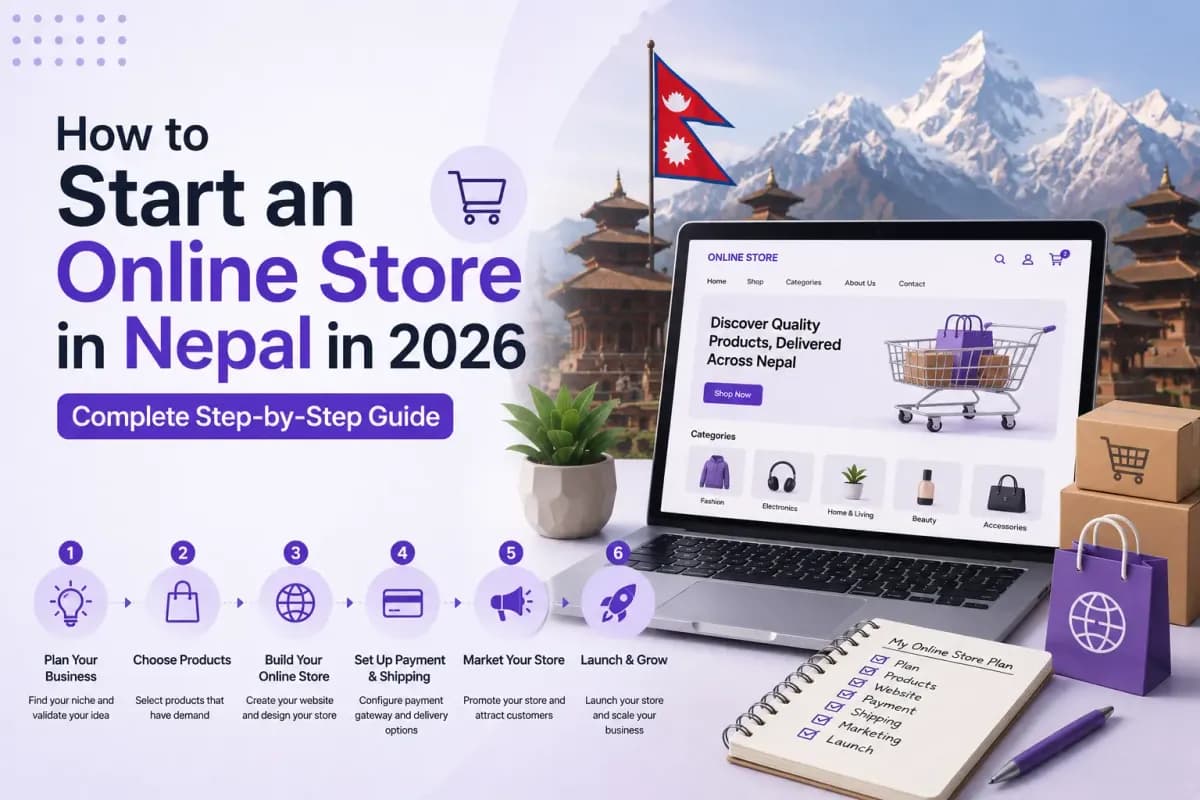
Starting an ecommerce business in Nepal is one of the smartest things you can do right now.
Online shopping in Nepal is growing. More people are buying things from their phones every day. Businesses with an online store make sales around the clock, even while they sleep. And starting your own ecommerce business in Nepal has never been this easy or this affordable.
But if you have never done it before, it can feel overwhelming. Where do you even start? What platform should you use? How do you accept eSewa and Cash on Delivery? How do you ship products? How do you get customers?
This guide answers all of those questions.
It is a complete, beginner-friendly walkthrough for anyone who wants to start an ecommerce business in Nepal in 2026. Simple language. No tech background needed. No jargon. Just clear steps that work.
By the end, you will know exactly what to do to go from zero to a live, working online store that accepts payments and takes orders.
Let us start from the beginning.
What's in this guide
Before you start
- Why start an ecommerce business in Nepal in 2026?
- What can you sell online in Nepal?
- What you need before you start
The ten steps
- Step 1: Decide what to sell
- Step 2: Find your products
- Step 3: Choose a name
- Step 4: Choose your platform
- Step 5: Build your store
- Step 6: Add your products
- Step 7: Set up payments
- Step 8: Set up delivery
- Step 9: Launch
- Step 10: Get your first customers
After launch
Why Start an Ecommerce Business in Nepal in 2026?
Let us start with the big picture.
Nepal's ecommerce market is growing, and digital payment adoption has moved faster than almost anyone predicted [VERIFY: the previous draft cited "USD 889 million in 2024" growing to "USD 3.94 billion by 2029." The 3.94bn figure appears to come from Statista's Digital Commerce dataset, which measures digital payment transaction value including travel and digital media, not retail ecommerce revenue. ECDB reports Nepal ecommerce revenue at roughly US$928m in 2025 with 0 to 5 percent growth. Pick one source, name it, and state which metric you are quoting].
Digital wallet adoption in Nepal is now very large [VERIFY: the previous "more than 10 million active digital wallet users" figure appears stale. Nepal Rastra Bank's mid-March 2026 indicators reported roughly 27.7 million wallet users and 29.5 million mobile banking users. Use NRB's published figures, which are authoritative and updated monthly]. People in Nepal are comfortable paying with their phone. They do not need to carry cash or visit a physical shop.
Here is the part that matters most. A large share of registered businesses in Nepal still have no proper online store [VERIFY: the "more than 250,000" figure was unsourced. Either find a citation or keep this qualitative]. Most are still selling only through Facebook pages or WhatsApp. That gap is your opportunity. If you start now, you are still early.
And unlike a few years ago, you do not need a web developer, a big budget, or technical knowledge. Modern platforms mean you can build a working online pasal in a day and take orders the same evening. Our breakdown of what an ecommerce website actually costs in Nepal covers the numbers honestly.
What Can You Sell Online in Nepal?
Before spending a rupee, understand what actually sells here.
Clothing and fashion. Kurtis, sarees, t-shirts, hoodies, traditional wear, kids' clothing, and accessories. Nepali buyers like shopping for clothes online because they can compare styles and get delivery to their door.
Handicrafts and handmade items. Pashmina shawls, Dhaka fabric products, handmade jewellery, Thangka paintings, singing bowls, wood carvings, pottery. Strong demand inside Nepal and from international buyers.
Electronics and phone accessories. Cases, chargers, earphones, power banks, cables, small gadgets. Buyers compare prices before purchasing, so a store with clear prices and good photos does well.
Organic food and health products. Teas, Himalayan products, spices, herbal items, dried fruits, honey. Health-conscious buyers actively search for these.
Beauty and personal care. Skincare, herbal face packs, hair oils, cosmetics. A fast-growing segment with a loyal, repeat-buying customer base.
Home and kitchen. Kitchen tools, decor, storage, bedding, small home improvement products.
Books, stationery, and gifts. Steady demand, especially around festivals and exam season.
Trekking and outdoor gear. Boots, backpacks, poles, sleeping bags. Nepal is a top trekking destination, so demand is built in, and it pairs naturally with tour and trekking businesses.
Choose a category you understand, where you know the products, and where you can compete on price, quality, or uniqueness.
What You Need Before You Start
Good news. Not much.
- A smartphone or computer (you have this already)
- A product or products to sell
- A bank account or mobile wallet
- A delivery address to ship from
- Basic product photos (your phone camera is fine)
That is it. You do not need to register a company right away. You do not need a tax number to start. You do not need to hire anyone. You can start from home with products you already have. Our guide to ecommerce company registration in Nepal covers when registration does become necessary.
Step 1: Decide What to Sell
This is the most important decision you will make. Everything else depends on it.
Many beginners skip this and start building the store first. That is a mistake. Decide clearly what you are selling, who your customers are, and why someone would buy from you instead of Daraz or a local shop.
Ask yourself:
- Do I already have access to this product, or do I need to source it?
- Is there demand for this online in Nepal right now?
- Can I offer better price, quality, or packaging than what exists?
- Is this bought once, or bought again and again?
Products people buy repeatedly are gold. Skincare, food, clothing, and household supplies create repeat customers and steady income.
If you are unsure, look at what sells well on Daraz Nepal or Sastodeal, and at popular Nepali selling pages on Facebook. Those categories have proven demand. You enter with better branding, better photos, or better pricing.
Start with 5 to 10 products maximum at launch. Do not list 200 from the beginning. Focus on a small selection, do it well, expand later.
Step 2: Find Your Products or Make Your Own
Three main routes:
You make it yourself. If you are a craftsperson, artist, baker, or maker, you are ahead. Handmade products have a built-in selling point because they are unique. Many successful Nepali online stores started with one person making things at home.
You buy wholesale and resell. The most common approach. Buy in bulk from a manufacturer or wholesaler and sell at retail. Source from local manufacturers, from Ason market in Kathmandu, from Indrachowk for handicrafts, or import through Alibaba and similar.
You dropship. You hold no inventory. When an order comes in, you buy from a supplier who ships directly to your customer. Still growing in Nepal, and it demands careful supplier relationships, but it is low risk to start.
For most beginners, buying wholesale and reselling is the most practical and profitable.
Step 3: Choose a Name for Your Online Store
Your store name matters more than people think. It is the first impression, and a good one builds trust.
Simple rules:
- Keep it short. One or two words. Three maximum.
- Make it easy to spell. If people cannot spell it, they cannot search for it.
- Make it relevant to what you sell where possible.
- Check the domain is available (.com or .com.np). You will need one.
- Check nobody else in Nepal is using it.
Avoid generic names like "Nepal Online Shop." They are hard to rank on Google and impossible to build a brand around.
Your name does not need to be perfect. Many successful Nepali businesses started with a simple name and built their reputation on service. Pick something you are comfortable with and move on. When you are ready, connecting your domain takes minutes.
Step 4: Choose the Right Platform to Build Your Store
This is where many beginners get stuck. Many platforms can build an online store, but not all are built for the Nepali market.
What you need from a platform in Nepal:
- Local payment integration (eSewa, Khalti, Fonepay, COD)
- Nepali language support, or at minimum local customer support
- Affordable pricing in Nepali rupees
- Local logistics support
- Usable if you are not technical
Your options
Daraz is a marketplace, not your own store. You list products, they take a commission. You do not own your customers, you have no control over your brand, and you depend entirely on their rules. Good for side income, not for building a brand. We compared the two properly in Daraz vs your own website, and you can see what the commissions cost with our Daraz commission calculator.
Facebook and Instagram work at very small scale but are not a real ecommerce business. No cart, no automatic payment processing, no order management, and the page can be restricted at any time.
Shopify is excellent globally but has real limitations for Nepal. Local wallet support requires third-party workarounds, billing is in USD, and support is not local [VERIFY: the previous draft claimed Shopify "does not natively support eSewa, Khalti, or COD." Cash on delivery is available on Shopify as a manual payment method, so that claim is inaccurate as written. Also re-check the USD 29 monthly figure, as Shopify has revised pricing]. Our Shopify in Nepal breakdown goes into detail, and we have the same for WordPress and WooCommerce and Wix.
Joomni is an AI-powered ecommerce platform built for the Nepali market, with eSewa, Khalti, Fonepay, and COD integration built in, pricing in Nepali rupees, and AI that writes product descriptions and builds your store pages [VERIFY: confirm all specific feature and pricing claims with your product team before publishing. See editor's notes]. Current plans are on the pricing page, and there is a fuller overview at ecommerce website builder Nepal.
For the rest of this guide we will use Joomni as the example platform, because it is built for Nepal and designed for people who are not technical. The steps translate to any platform.
Step 5: Build Your Online Store
With a modern platform, this is easier than most people expect.
Sign up and choose your plan. Create an account and start with the entry plan to test things before committing. Upgrade when you are ready to go live with full ecommerce features.
Choose your store template. Pick a design that fits your category. Selling clothes? A fashion template. Selling food? Something clean that shows products appealingly. Customise colours, fonts, and layout to match your brand.
Set up your store details. Store name, logo, contact information, location, and a short description of what you sell. This builds trust with first-time visitors.
Add your domain name. Connecting your own domain makes your business look far more professional. Customers are more likely to buy from "NepalCrafts.com" than a subdomain.
Our first launch guide covers each of these in order.
Step 6: Add Your Products the Right Way
How you list products decides whether people buy. Do not just upload a photo and a price.
Take good product photos. You do not need an expensive camera. Use natural light near a window. Use a clean, simple background, white or light grey. Shoot from multiple angles. Show the product in use where possible.
Write a good product title. Include colour, material, size, and key features. Instead of "Shawl," write "Handmade Pashmina Shawl in Maroon, 100% Pure Wool, Made in Nepal." The second is better for customers and for Google.
Write a helpful description. Simple, honest language. Answer the questions a customer would have: what it is made of, what size, who it is for, how to use or care for it. Our guide to writing product descriptions that rank covers what turns a description into a search result, and AI tools for Nepali online stores covers drafting them faster.
Set your price clearly. Include delivery charges or state clearly that delivery is free. Surprise costs at checkout are one of the biggest reasons orders get abandoned.
Set your inventory. Enter stock levels so your store shows "Out of Stock" automatically and you do not take orders you cannot fill. Product and catalogue setup covers this.
Step 7: Set Up Payments (eSewa, Khalti, COD and More)
This is one of the most important steps. If customers cannot pay how they prefer, they will not buy.
eSewa is Nepal's largest digital wallet and the default choice for many online shoppers. You need a merchant account to accept it.
Khalti is the other major wallet with a large, loyal user base. Many buyers specifically prefer it, so having both matters.
Fonepay connects to almost all Nepali bank accounts through QR. It opens payment to people who do not use wallets but do have a bank account.
Cash on Delivery (COD) is critical in Nepal. A large majority of online orders here are still paid on delivery [VERIFY: the "over 90 percent" figure was unsourced. Find a citation or say "the majority"]. Many buyers still want to see the product before paying.
If you do not offer COD, you lose a large share of potential customers. This is not optional in Nepal.
QR code payment through Nepal Rastra Bank's standard lets customers pay from any banking app, and it is becoming very popular.
International payments through Stripe or PayPal matter if you plan to sell abroad, which is realistic for handicrafts and pashmina.
Our payment gateway documentation walks through connecting each one, and the payment fee calculator shows what you actually keep per order across methods.
Step 8: Set Up Delivery and Shipping in Nepal
A great product and working payments are not enough. Delivery is one of the most common reasons customers leave bad reviews or never return.
Choose your delivery partners. The main options for Nepali ecommerce are Pathao, Lalamove, SRS Express, and various local couriers. Inside Kathmandu Valley, same-day or next-day is achievable. Outside the Valley, national couriers cover most districts.
Set your delivery zones and charges. Decide where you deliver and what you charge. Many Nepali stores offer free delivery inside the Valley and a flat rate outside. Showing delivery charges before checkout reduces cancellations.
Set realistic delivery times. Inside Kathmandu, 1 to 2 days is normal. Outside, 3 to 7 days depending on location. Overpromising costs you repeat customers and earns negative reviews.
Package properly. Good packaging protects products and creates a good first impression. You do not need to spend much, but a clean, sealed package with your logo sticker beats a random plastic bag.
Handle returns professionally. Have a clear, simple return policy on your site. Accepting returns builds trust significantly. Most successful Nepali stores accept returns within 7 days for undamaged, unused items.
Step 9: Launch Your Store
Before you publish, run this checklist:
- Open your store on your phone. Most Nepali customers arrive on mobile, not laptop.
- Place a test order yourself and check checkout works end to end.
- Confirm all payment options display and function correctly.
- Make sure phone number, email, and address are clearly visible.
- Re-read your product descriptions for spelling mistakes.
- Check delivery information and return policy are clearly stated.
When everything checks out, publish. Your ecommerce business in Nepal is live.
Step 10: Get Your First Customers
Having a store is one thing. Getting people to visit and buy is another. This is where many new Nepali sellers get stuck.
Tell everyone you know first. Family, friends, colleagues, neighbours. Ask them to share. Your first sales almost certainly come from your existing network, and they help you find problems in ordering, payment, and delivery before you scale.
Share on Facebook and Instagram. Create a page for your store. Post product photos with clear prices and your store link. Reply to comments and messages fast. Post at least 3 to 5 times per week.
Join Facebook groups. Hundreds of Nepali buy-and-sell groups let you post products free. Local city groups and niche interest groups related to your products are free advertising.
Use TikTok. Growing extremely fast in Nepal, especially among younger buyers. Short videos of products being used, packaged, or made can generate large organic reach with zero ad spend.
Ask happy customers for reviews. Message after each order and ask for a photo or review. Social proof carries enormous weight in Nepal because buyers trust real people.
Try small paid ads. Once you have made a few sales and know your products work, test Facebook ads on a small daily budget before scaling. Our comparison of marketing channels and their actual returns helps you decide where the money goes.
Focus on SEO from day one. Make sure your titles and descriptions include the words people actually search. If you sell pashmina, "pashmina shawl Nepal" and "buy pashmina shawl online" should appear naturally in your product pages. Our complete ecommerce SEO guide covers the fundamentals, and if you also serve walk-in customers, ranking for "near me" searches captures local intent.
Build your customer list from the first sale. Collecting emails and phone numbers lets you bring customers back with automated campaigns rather than paying to reach them again.
What Does It Cost to Start an Ecommerce Business in Nepal?
The honest answer: it can be very affordable if you are smart about it.
Platform cost. A hosted platform subscription covers your website, hosting, SSL, and payment integrations in one monthly fee. Compare that to hiring a developer to build a basic site without ongoing support. Current plans are on our pricing page.
Domain name. A .com runs roughly NPR 1,500 to 2,000 per year. A .com.np is around NPR 2,000 per year [VERIFY]. Optional at the start if you use a free subdomain, but strongly recommended.
Initial stock. Entirely dependent on what you sell. Small items like accessories or handmade products can start very small. Many successful Nepali stores started with products already at home or stock already selling in a physical shop.
Photography. Free if you shoot on your phone. Professional product shoots in Kathmandu cost more [VERIFY current rates].
Marketing. You can start at zero using Facebook groups, Instagram, TikTok, and word of mouth. Add paid advertising once you know what sells.
In total, you can realistically start with a small four-figure to low five-figure rupee budget, covering your first month of platform subscription, a modest initial stock, and basic marketing. That is one of the lowest startup costs of any business type.
For a full line-by-line breakdown including the bootstrap route, see what an ecommerce website costs in Nepal.
Common Mistakes New Online Sellers in Nepal Make
Not setting up COD. Some new sellers offer only eSewa or Khalti and wonder why nobody buys. Most Nepali customers still prefer paying on delivery. Always offer it.
Bad product photos. Online, your photos are your product. Customers cannot touch or try things. Dark, blurry, or cluttered photos kill sales.
Hidden delivery charges. Nothing frustrates shoppers more than a surprise cost at checkout. Be upfront about everything.
Trying to sell everything to everyone. Listing 100 products across 10 categories creates a confusing store that is impossible to market. Start focused, expand once you have traction.
Slow replies. Nepali customers expect fast responses. Two days of silence means they have already bought elsewhere. Reply within a few hours.
No returns policy. Many new sellers fear returns. A clear, fair policy actually increases sales, because buyers feel safer.
Giving up too early. Most Nepali ecommerce businesses take 2 to 3 months to reach consistent sales. Many beginners quit after two weeks and one or two orders. Keep improving products, photos, marketing, and service.
Frequently Asked Questions
Can I start an ecommerce business in Nepal without registering a company?
Yes, you can start selling online as an individual, and many small sellers do. However, setting up a proper eSewa or Khalti merchant account requires some documentation. As you grow, registering as a sole proprietorship or private limited company is recommended for legal protection and credibility. Our guide to ecommerce company registration covers the process.
Do I need a lot of money to start an online store in Nepal?
No. You can start very small. If you already have products to sell, your total startup cost can be modest. The platform subscription and a small initial stock are the main costs. See pricing and our full cost breakdown.
What is the best payment method for online stores in Nepal?
Cash on Delivery remains the most important, because the majority of Nepali online buyers still prefer paying on delivery. After COD, offer eSewa and Khalti, the two most popular digital wallets. Having all three is the best setup for any Nepali store.
How do I deliver products to customers outside Kathmandu?
National courier services including SRS Express, Himalayan Shipping Service, and Bhugol Courier reach most districts. Pathao and Lalamove cover inside the Valley. Outside Kathmandu, expect 3 to 7 days depending on location.
Do I need a website, or can I sell only on Facebook?
You can start on Facebook, but it is not a real ecommerce store. No cart, no automatic payment processing, no order management, and the page can be restricted at any time. A proper website with your own domain builds far more trust and gives you full control. Facebook is excellent for marketing traffic to your store, not for being the store.
Is ecommerce profitable in Nepal?
It can be. The market is growing and competition is still relatively low compared with other countries. The key is choosing the right products, pricing well, providing good service, and marketing consistently. [VERIFY: the previous draft claimed "many small sellers in Nepal are making NPR 50,000 to NPR 200,000 or more per month." Specific income claims like this need real data behind them or they should be cut. See editor's notes.]
Can I sell internationally from Nepal?
Yes. Accept Stripe and PayPal and ship through FedEx, DHL, or Aramex. Nepali handicrafts, pashmina, and organic products are in demand from buyers in the USA, Europe, and Australia. It takes more setup but opens a much larger market.
How long does it take to build an online store in Nepal?
On a modern hosted platform, a working store can be live in a day. AI tools help you build pages and write descriptions quickly. Launch in the morning, share it in the afternoon.
Do I need to pay taxes on my online store sales in Nepal?
If you operate as a registered business, you are expected to comply with applicable tax law, including VAT if your revenue exceeds the Inland Revenue Department's registration threshold. Consult a local accountant as your business grows to understand your specific obligations.
Nepali ma padhna man cha? Hamro website kasari banaune guide hernuhos.
Final Thoughts
Starting an ecommerce business in Nepal in 2026 is one of the best business decisions available. The market is growing, the tools are affordable and easy to use, and most Nepali businesses are still not online. The opportunity is genuinely there for people who act.
You do not need to be a tech expert. You do not need a big investment. You do not need to code. You need a product, a clear plan, and consistent effort.
Follow the steps here. Set up eSewa, Khalti, and COD. Take good photos. Market through Facebook and TikTok. Be responsive to customers.
Start simple. Start small if you have to. But start.
The best time to start your ecommerce business in Nepal was two years ago. The second best time is today.
Ready to build your store? Start with Joomni and have it live today, or compare plans first. No coding needed, no experience required.
Written by
Admin