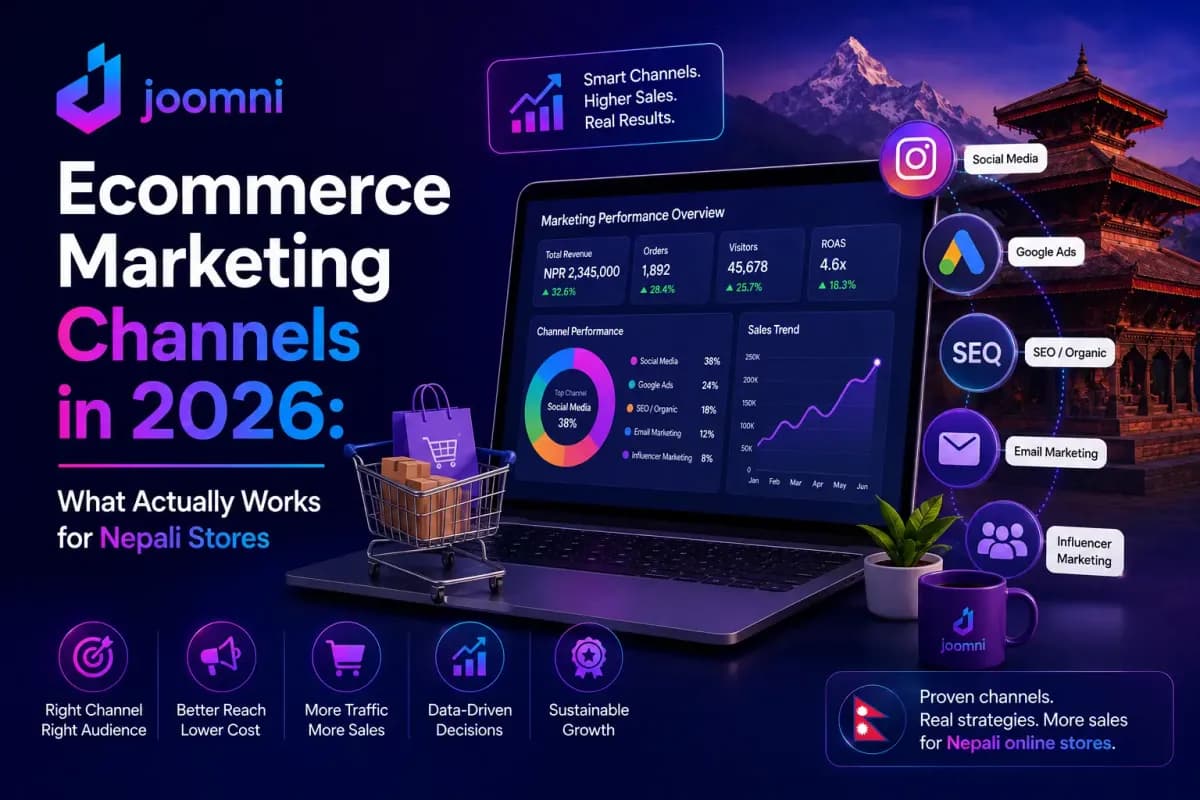
Most guides to ecommerce marketing channels are written for stores selling in the US or Europe. They assume you can run Google Shopping at full scale, join an affiliate network, sign up with an American SMS platform, and spend a few thousand dollars a month testing.
If you are running a store in Nepal, several of those assumptions do not hold, and following that advice means burning budget on channels that will not work here while ignoring the ones that will.
This guide covers the same twelve channels, but honestly: which are fully available in Nepal, which are restricted, which are effectively closed, and which ones nobody writing from San Francisco would think to mention.
Budgets are in rupees, at a scale a real Nepali business can actually commit.
What's in this guide
- A note on the ROI numbers you see elsewhere
- Channel availability in Nepal at a glance
- The channels that work best here
- Worth adding as you grow
- Available but with real caveats
- Budget allocation by stage
- Attribution: knowing what actually worked
- A 90-day plan
- Frequently asked questions
A Note on the ROI Numbers You See Elsewhere
You have probably read that email marketing returns 42 rupees for every 1 spent, that SMS achieves 98% open rates, or that affiliate marketing delivers 8 to 15 times return.
Treat all of these with caution.
Most circulate without a named source, a date, or a description of the businesses measured. Many originate from vendor marketing (an email platform publishing email ROI research is not a neutral party) or from surveys of large Western retailers whose economics look nothing like a Kathmandu store's.
Open rate figures in particular are unreliable, because mail privacy features now pre-load images and register opens whether or not anyone reads the message. Industry averages rose for reasons unrelated to marketing quality.
So this guide gives you relative guidance rather than false precision: which channels tend to return more per rupee for Nepali businesses, which cost more to run, and what to expect on timing. Your own numbers will differ from any benchmark, which is why the attribution section below matters more than any table of averages.
Channel Availability in Nepal at a Glance
Before budgeting, know what you can actually use.
Fully available Facebook and Instagram ads, TikTok organic content, SEO, content marketing, email, YouTube, local SMS through Nepali providers, Viber and WhatsApp messaging, retargeting, and marketplace selling on Daraz.
Available with caveats Google Search ads work normally. Google Shopping and free product listings are available for Nepal, but Nepal is classified as a beta country, which means participation may be limited to certain retailers and performance can differ from established markets. Worth testing, not worth building your plan around. [VERIFY: re-check Nepal's beta status before publishing, as Google moves countries out of beta periodically.]
Restricted or effectively closed [VERIFY: confirm current availability for each of these before publishing, as platform coverage changes:]
- TikTok Shop and TikTok ads. TikTok Shop operates in selected markets and TikTok's ad platform is not available everywhere. Organic TikTok is fully open to you regardless.
- Pinterest ads. Pinterest's advertising platform is available in a limited set of countries. Organic pinning works anywhere.
- International affiliate networks (ShareASale, CJ, Rakuten, Impact) generally require a business entity, bank account, and payment method in a supported country.
- US-focused SMS platforms (Postscript, Attentive, SMSBump) do not typically support Nepali numbers. Use a local bulk SMS provider instead.
None of this means those channels are worthless. It means the paid, platform-managed version is closed while the organic version is open, and you should plan accordingly rather than discovering it after signing up.
Tier 1: The Channels That Work Best Here
These four deliver the most per rupee for most Nepali stores. Get all four working before touching anything else.
1. SEO and content
Organic search is the largest single traffic source for most online stores, and in Nepal it is unusually winnable because so few local competitors have done the work.
Why it matters more here. Competition for Nepali search terms is a fraction of what it is in mature markets. Ranking for "pashmina shawl Nepal" or "gym in Baneshwor" is achievable in months, not years, and once you rank, the traffic costs you nothing ongoing.
What to do: target commercial-intent keywords combining product and place. Write proper product pages rather than copying supplier text. Publish buying guides and comparison content that catches people earlier in their decision. Fix your technical foundation: speed, mobile, clean URLs, internal links.
Our complete ecommerce SEO guide covers the full method, and writing product descriptions that rank covers the page-level work.
If you also serve walk-in customers, local SEO and Google Maps belongs in this tier too and is often faster to win than general search.
Cost: your time, or NPR 10,000 to 30,000 monthly for freelance help. Timeline: first movement at 3 to 6 months, real traction at 12.
2. Facebook and Instagram
Meta remains the dominant paid channel in Nepal, and the cost per result is still low compared with most markets.
What works: broad targeting rather than narrow interest stacking, since the algorithm now finds buyers better than manual targeting does. Creative that stops the scroll in the first second. Retargeting people who visited but did not buy, which almost always outperforms cold traffic. Dynamic product ads that show people exactly what they looked at.
A Nepal-specific note: many of your customers will message rather than checkout. Treat Messenger conversations as a conversion path, not a distraction, and make sure someone answers quickly.
Starting budget: NPR 15,000 to 30,000 monthly is enough to gather usable data. Below roughly NPR 500 per day you will struggle to learn anything reliable.
3. Messaging: Viber, WhatsApp, and SMS
This is the channel international guides ignore and Nepali businesses should not.
Your customers already message you. They reply there. Automated flows on Viber or WhatsApp reach people who will never open an email, and local bulk SMS through Nepali providers costs very little per message.
What to automate: order confirmations and delivery updates, abandoned cart reminders, review requests after delivery, and festival campaigns.
The discipline required: tolerance for over-messaging is far lower than email. A daily promotional SMS loses customers. Keep it to genuinely useful and genuinely occasional.
Our guide to AI email and messaging automation covers the automation side in depth, including when email is and is not the right channel here.
Cost: low. Local SMS is priced per message, and messaging automation is often included in your store platform, as it is in Joomni's messaging tools.
4. Email, for the right segments
Email is not dead in Nepal, it is just narrower than elsewhere. It works well for B2B, professional services, international and diaspora customers, and transactional messages that everyone opens.
It works poorly for everyday consumer retail where customers rarely check personal email.
Build the list anyway. It is an owned asset that no platform can take from you, and it costs almost nothing to collect addresses at checkout.
Priority automations: welcome sequence, abandoned cart, post-purchase follow-up.
Tier 2: Worth Adding As You Grow
5. TikTok, organically
TikTok's reach in Nepal is substantial and growing fastest among younger buyers. The algorithm surfaces content regardless of follower count, which means a new account can reach large audiences on merit.
Even where TikTok's paid tools are unavailable to you, organic content costs nothing but time, and Nepali businesses have built real customer bases from it without spending on ads.
What works: authentic and unpolished beats produced. Show how things are made, packed, or used. Participate in trends. Go live.
6. Retargeting
Only a small fraction of first-time visitors buy. Retargeting brings the rest back and consistently returns more per rupee than cold traffic, because the audience already knows you.
Setup: install the Meta pixel at minimum, plus Google's if you run search ads. Segment by behaviour: all visitors, product viewers, cart abandoners, past buyers. Show cart abandoners the product they actually looked at.
Discipline: cap frequency. Following someone around the internet with the same ad ten times a day annoys them and wastes budget.
Budget: 15 to 25% of your paid advertising.
7. Content marketing and blogging
Distinct from SEO in emphasis: SEO is about product pages ranking, content is about earning trust and attracting people earlier in their decision.
Buying guides, comparisons, how-to articles, and answers to questions your customers actually ask. In Nepal this is unusually effective because so little quality local content exists in most categories.
Cost: time, or NPR 3,000 to 10,000 per commissioned article. Timeline: 12 to 24 months to full effect, and it compounds.
8. Influencer and creator partnerships
Nepal has a large and relatively affordable creator ecosystem, and trust in recommendations runs high here.
Focus on micro and nano creators. Someone with 15,000 engaged followers in your city will usually outperform a national name, at a fraction of the cost.
Structure it properly: unique discount codes so you can measure what each partnership actually returned. Longer relationships over one-off posts. Creative freedom within clear guidelines.
Budget: 10 to 20% of marketing spend. Rates vary widely, and product-only partnerships are common at the smaller end.
9. Google Search ads
Search ads capture people who are already looking, which makes them the highest-intent paid traffic available.
Where it works in Nepal: categories where people search in English with commercial intent, higher-value products, and services. Less useful for low-value items where the click cost eats the margin.
Start narrow. Two or three keywords tied to your most profitable product. Build a negative keyword list from day one. Test Google Shopping alongside it, accepting that Nepal's beta status means results may be inconsistent.
Starting budget: NPR 15,000 to 25,000 monthly to gather meaningful data.
Tier 3: Available But With Real Caveats
10. YouTube
High production effort, slow to build, but the content keeps working for years and YouTube functions as a search engine for product research.
Worth it if you have something genuinely demonstrable. Not the first place to spend a limited budget.
11. Affiliate and referral
International affiliate networks are largely inaccessible from Nepal. But the underlying mechanic works fine without them.
Build a simple referral scheme: unique discount codes for partners, commission paid manually, tracked in a spreadsheet. Recruit bloggers, creators, and complementary businesses directly. It is less automated and entirely functional.
You only pay on completed sales, which makes it one of the lowest-risk things on this list.
12. Pinterest and marketplace channels
Pinterest organic pinning works and drives some referral traffic, particularly for visual categories like fashion, handicrafts, and home. Paid Pinterest is likely unavailable to you.
Daraz deserves a mention here that international guides would never make. For most Nepali sellers it is a legitimate acquisition channel, not just a competitor. Use it for discovery and product validation while building your own store as the asset you keep. We covered the trade-offs fully in Daraz vs your own website, and the commission calculator shows what that reach actually costs you.
Budget Allocation by Stage
Percentages, not absolute figures, so they hold whatever your budget is.
Just starting (first year)
You need sales now and assets later.
- 35% Facebook and Instagram ads
- 20% SEO and content foundation
- 15% retargeting
- 15% messaging automation and list building
- 10% organic TikTok and social content
- 5% testing
Realistic total: NPR 25,000 to 50,000 monthly. Below this, concentrate everything on Meta ads and organic content rather than spreading thin.
Growing (year one to three)
Balance acquisition against retention.
- 25% social ads (Meta plus TikTok where available)
- 20% SEO and content
- 15% Google Search
- 15% messaging and email
- 15% retargeting
- 10% creator partnerships
Established (three years plus)
Efficiency and customer lifetime value.
- 20% social ads
- 20% SEO and content
- 20% messaging and email
- 15% search
- 15% retargeting
- 10% partnerships, referral, and testing
Seasonal adjustment
Increase paid spend substantially before and during Dashain and Tihar, when buying intent peaks. Start building audiences six weeks ahead so your retargeting pools are full when it matters.
Pull back during slow months and redirect to SEO, content, and looking after existing customers.
Always reserve for testing
Keep 10 to 15% for trying things. Channels change, platforms open up in Nepal that were previously closed, and your competitors are mostly not experimenting.
Attribution: Knowing What Actually Worked
Customers touch several channels before buying, so simple "which channel gets the credit" thinking will mislead you.
Last-click attribution credits whatever they touched immediately before buying. It systematically overvalues retargeting and branded search while making the channels that created the demand look worthless.
First-click does the opposite.
The practical approach for a small business: use Google Analytics 4, tag every campaign with consistent UTM parameters, and look at assisted conversions, not just last click. A channel with few direct conversions but many assists is doing real work.
Ask your customers. Genuinely. "How did you hear about us?" at checkout or in a follow-up message gives you information no analytics tool can, particularly in Nepal where a lot of discovery happens in Facebook groups, on Viber, and through word of mouth that no pixel will ever see.
Run holdout tests. Pause a channel for two weeks and watch what happens to total revenue, not just that channel's numbers. This is the only reliable way to know whether a channel is generating sales or taking credit for sales you would have made anyway.
A 90-Day Plan for a Nepali Store
Days 1 to 30: foundation
Week 1. Audit what you are already doing. Set up Google Analytics 4, install the Meta pixel, and agree a UTM naming convention.
Week 2. Messaging and email foundation. Choose your tool, build a welcome flow and an abandoned cart flow, and add capture points on your site. Cheapest fastest return available.
Week 3. Claim and optimise your Google Business Profile if you have any physical presence. Free, fast, and frequently the highest-return afternoon of work in this whole plan.
Week 4. Launch your first Meta campaign. One clear offer, broad targeting, several creative variations.
Days 31 to 60: expansion
Week 5. Turn on retargeting. Segment by behaviour, use dynamic product ads.
Week 6. Content foundation. Keyword research, a content calendar, and your first two articles targeting commercial keywords.
Week 7. Start posting on TikTok and Instagram organically. Three posts a week minimum. Costs nothing but consistency.
Week 8. Approach three or four micro-creators in your category with a small paid or product partnership and unique discount codes.
Days 61 to 90: optimise and scale
Week 9. Review everything. Which channels produced sales? What did each cost per order?
Week 10. Scale what worked. Increase budget on profitable campaigns, produce more of the creative that performed.
Week 11. Test one new channel. Google Search or Shopping, or a referral scheme, depending on where your gaps are.
Week 12. Plan the next quarter and set targets. If Dashain is approaching, this is when the festival campaign gets built.
Frequently Asked Questions
How much should a Nepali online store spend on marketing?
A common starting point is 10 to 20% of revenue, higher when you are trying to grow fast and lower when optimising for profit. In absolute terms, NPR 25,000 to 50,000 monthly is enough to run Meta ads properly and build organic foundations at the same time. Below that, pick one paid channel and do it properly rather than splitting a small budget four ways.
Which single channel should I start with?
Facebook and Instagram ads for immediate sales, alongside SEO and content for the long term. The mistake is choosing between them. Paid buys you time to let organic mature, and organic reduces how much paid you need later.
Can I run Google Shopping ads from Nepal?
Yes, but Nepal is currently a beta country for Shopping ads and free listings, which means availability may be limited to certain retailers and performance can be less consistent than in established markets. Test it, measure it, and do not build your plan around it until you see it working for you.
Is TikTok worth it if the paid tools are limited here?
Organic TikTok is worth it regardless. The algorithm distributes on merit rather than follower count, reach in Nepal is substantial, and it costs nothing but time. Several Nepali businesses have built their entire customer base there without spending on ads.
How do I do affiliate marketing without access to the big networks?
Manually, and it works fine. Give partners a unique discount code, agree a commission, track it in a spreadsheet, and pay monthly. You lose the automation and keep the entire mechanic. Bloggers, creators, and complementary local businesses are all worth approaching directly.
Should I still sell on Daraz?
For most sellers, yes, at least initially. It brings discovery you cannot buy cheaply elsewhere and validates whether a product sells before you invest in your own traffic. The problem is dependency rather than presence. Treat it as one channel while your own store becomes the asset you actually own.
How long before marketing shows results?
Paid ads produce data within days and sales within weeks. Messaging automation starts returning almost immediately once the flows are live. SEO and content take three to six months to move and twelve to eighteen to mature. Plan for both timescales at once, because relying only on paid means your costs never come down.
The Bottom Line
The stores winning in Nepal are not the ones with the biggest budgets. They are the ones running two or three channels properly instead of eight badly.
Start with Meta ads and messaging automation for near-term sales. Build SEO and content underneath so your acquisition cost falls over time. Add retargeting as soon as you have traffic worth retargeting. Everything else is expansion once those four are working.
And measure honestly. Ask customers how they found you, run holdout tests, and be willing to cut a channel that looks good in a dashboard but does not show up in revenue.
Building the store all this points at? Start with Joomni, or compare plans.
Nepali ma padhna man cha? Hamro website kasari banaune guide hernuhos.
Written by
Admin