Think about this for a second.
Five years ago, having an online store in Nepal was enough to stand out. You just needed a Facebook page, some product photos, and a phone number. Customers would come automatically.
But in 2026? The game has completely changed.
Nepal now has millions of active social media users [VERIFY: DataReportal's Digital 2026 Nepal report puts social media user identities at 14.8 million as of October 2025, which is far above the "over 4 million" figure in the original draft. Update or cut]. Thousands of sellers are competing for the same customers on Facebook, Instagram, Daraz, and TikTok. Your customers see hundreds of product posts every single day. They are smarter, more demanding, and less patient than ever before.
They want instant replies to their messages. They want high quality product photos. They want clear and detailed product descriptions. They want fast delivery, and they want to feel trust and professionalism from the sellers they buy from.
And you as a small business owner are expected to deliver all of this, often alone, without a big team or a huge budget.
That sounds exhausting, right?
Here is the good news. You do not have to do all of this manually anymore.
Artificial Intelligence, which people call AI, is now powerful enough to write your product descriptions, reply to your customers at midnight, design your ads, edit your photos, make your videos, and even tell you what products to restock. And the best part is that most of these AI tools are either free or very affordable, even for small sellers in Nepal.
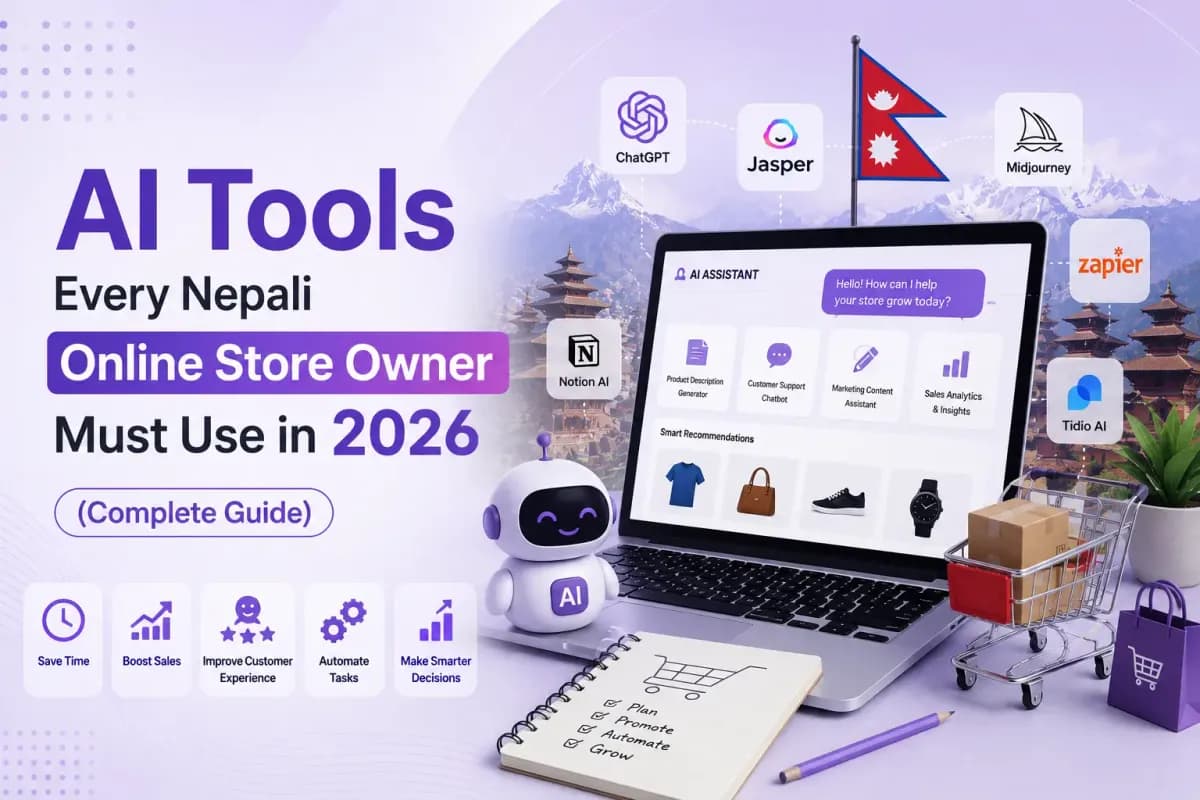
In this guide, you will learn about the 10 best AI tools that smart Nepali online store owners are already using in 2026 to work smarter, sell more, and grow faster. Whether you are selling on Daraz, running a Facebook shop, managing your own website, or posting on Instagram, these tools are built for you.
Let us get started.
What's in this guide
- What is AI, and why should Nepali sellers care?
- 1. ChatGPT: your business assistant
- 2. Canva AI: professional product visuals
- 3. Tidio: the AI chatbot that catches every sale
- 4. Grammarly: write with confidence
- 5. AdCreative.ai: ads that actually convert
- 6. Remove.bg: clean product photos in seconds
- 7. Pictory AI: product videos without editing skills
- 8. Jasper AI: bulk marketing content
- 9. Google Merchant Center: high-intent shoppers
- 10. AI built into your store platform
- Which tools to choose at your stage
- Common mistakes to avoid
- Quick reference summary
- Frequently asked questions
What Is AI and Why Should Nepali Online Sellers Care?
AI stands for Artificial Intelligence. It means computer programs that can think, learn, and make decisions on their own, a bit like a human brain but much faster.
When you type a message to ChatGPT and it writes a full product description in five seconds, that is AI. When Canva automatically suggests a layout for your Dashain sale poster, that is AI. When a chatbot answers your customer's question at 3 AM while you are sleeping, that is also AI.
AI does not replace you as a business owner. It works for you. Think of it like hiring a very fast, very cheap assistant who never gets tired, never takes leave, and never makes excuses.
For Nepali online sellers working with limited time and limited budget, AI tools are not just helpful. In 2026, they are necessary. If you want the broader picture beyond store-specific tools, our guide to using AI to grow a small business in Nepal covers the same shift across service businesses too.
1. ChatGPT: Your Smartest and Most Hardworking Business Assistant
What it is
ChatGPT is an AI tool made by OpenAI. You type something and it replies like a very intelligent person. You can ask it to write things, explain things, plan things, or solve problems.
Why Nepali sellers need it
Let us be honest. Writing product descriptions is boring and takes forever. Coming up with captions every single day is exhausting. Thinking about what to say during Dashain or Tihar takes hours.
ChatGPT does all of this in seconds.
Here is a real example. Suppose you sell handmade Dhaka fabric bags from Palpa. Instead of sitting for an hour, you tell ChatGPT:
"Write a product description for a handmade Nepali Dhaka fabric bag from Palpa. The target customers are young Nepali women aged 18 to 30 who care about traditional culture and fashion. Make it sound warm and exciting."
Within ten seconds you have a professional description you can paste straight into your store. That one action just saved an hour.
More ways to use it
- Write polite, professional replies to customer complaints
- Create a full 30-day content calendar for your Facebook page
- Write festival sale announcements for Dashain, Tihar, and New Year
- Draft your About Us page
- Generate product ideas based on current trends
One of the most powerful things about ChatGPT in 2026 is that it understands Nepali far better than before. You can write prompts in Nepali and get Nepali responses, which is a huge advantage for sellers more comfortable in their mother tongue.
A caution worth stating: a description that reads well is not automatically a description that ranks. Our guide to writing product descriptions that rank on Google covers what to add to an AI draft so it earns search traffic rather than just filling the page.
Pricing: the basic version is free. The paid tier costs around USD 20 per month [VERIFY: confirm current ChatGPT Plus pricing and the NPR conversion]. For most small Nepali sellers, the free version is more than enough to start.
Skill level: zero. If you can type a message on Messenger, you can use ChatGPT.
2. Canva AI: Make Your Products Look Professionally Designed
What it is
Canva is an online design tool that lets anyone create good-looking graphics without design skills. In 2026 it has become more powerful because it now uses AI throughout.
Why visuals matter so much in Nepal
Here is an uncomfortable truth. Most people decide whether to buy within the first few seconds of seeing a product [VERIFY: the original claimed "3 seconds"; either cite a source or keep this qualitative]. If your photo looks blurry, your poster looks messy, or your ad looks like it was made in 2010, customers scroll past without a second thought.
Professional visuals build trust. Trust leads to sales.
The problem is that hiring a graphic designer costs money and takes time. Many sellers in Birgunj, Dhangadhi, or Hetauda do not even have access to good designers. Canva AI solves this.
Key AI features
Magic Design takes a product photo and automatically generates multiple design options you can pick from and customize.
AI background remover strips the background from a product photo in one click.
Magic Write generates the text for your designs, so you are not staring at a blank Tihar sale poster.
Canva also has thousands of templates built for Facebook posts, Instagram stories, product banners, and flyers. Replace the text and images with your own and you are done in minutes.
Pricing: the free plan is generous and includes hundreds of templates and basic AI features. Pro costs roughly NPR 1,500 per month and unlocks premium templates and the full AI feature set.
3. Tidio: The AI Chatbot So You Never Miss a Sale
What it is
Tidio is an AI-powered chatbot you add to your website or connect to your Facebook page. It replies to customer messages automatically, answers common questions, and guides people through buying, even while you sleep.
The problem it solves
How many times has this happened? A customer messages at 11 PM asking "Do you deliver to Chitwan?" or "What is your return policy?" You are asleep. You see it in the morning. By then they have bought from someone else.
This is one of the most common reasons Nepali sellers lose sales. Not bad products. Late replies.
What it can answer automatically
You train Tidio by entering your common questions and answers: delivery areas, cash on delivery policy, delivery times, available sizes, stock status. Once set up, it handles all of these on its own, and you only step in for complex questions.
Instant replies matter enormously in a market where dozens of sellers offer similar products. Being first to respond is frequently the deciding factor.
Tidio also collects customer details and can send automatic follow-ups to people who showed interest but did not buy, which recovers sales that would otherwise vanish. If you want to go further with that, automated email and messaging campaigns handle the longer follow-up sequences, and most store platforms include built-in messaging tools so you're not stitching three services together.
Pricing: the free plan is capable and suitable for small stores. Paid plans start around USD 19 per month.
4. Grammarly: Write With Confidence Every Time
What it is
Grammarly is an AI writing assistant that checks and corrects spelling, grammar, punctuation, and style in real time as you type.
Why Nepali sellers need it
Many talented Nepali entrepreneurs have excellent products but find writing professional English content difficult. Maybe English was not your strongest subject. Maybe you know what you want to say but are unsure of the grammar.
These small mistakes seem harmless but they shape how customers perceive your store. A listing with spelling errors looks careless. A complaint response with grammatical mistakes looks unprofessional. Buyers, especially international ones, often choose the seller who communicates more clearly.
How sellers use it
Product titles and descriptions on Daraz or your website. Replies to customer messages. Emails to suppliers. Facebook and Instagram posts as you write them.
The premium version also suggests better word choices and can adjust tone to sound friendlier, more formal, or more persuasive.
Pricing: free for grammar and spelling. Premium costs approximately USD 12 per month.
5. AdCreative.ai: Facebook and Instagram Ads That Convert
What it is
AdCreative.ai is built specifically to create high-converting ad images and copy for Facebook, Instagram, and Google. It has been trained on large volumes of successful ads to generate creative designed to make people click.
Why most Nepali sellers waste money on Facebook ads
Every week, hundreds of Nepali sellers boost a post, spend NPR 2,000, get a few likes, and wonder why nobody bought.
The usual culprit is the creative, meaning the image and text. Most sellers use a plain product photo with simple text, which blends into the feed and gets ignored.
How it works
Upload your product image, add your logo and brand colours, describe your product and target customer. AdCreative.ai generates dozens of options ranked by predicted performance. You pick one and run it. The whole process takes about ten minutes.
Who it's for
Sellers already spending on paid ads who want better results from the same budget. If ads are not yet a meaningful line item for you, compare channels and their actual returns first before adding another subscription.
Pricing: plans start from around USD 21 per month.
6. Remove.bg: Professional Product Photos in Seconds, for Free
What it is
Remove.bg is a free AI tool that removes the background from any photo in about three seconds, giving you a clean transparent or white background.
Why every Nepali seller needs it
Look at the top-selling products on Daraz Nepal. Almost all have clean white or plain backgrounds. They look professional and focused on the product.
Now look at smaller sellers. Photos of products on a bed, on the floor, on a cluttered table. The background distracts the eye and makes the product look less valuable.
Professional product photography in Kathmandu costs roughly NPR 500 to 2,000 per product. For 50 products that is a serious expense. Remove.bg eliminates it. You take the photo on your phone and it cleans it up for free.
Practical uses
Clean images for Daraz listings. Consistent photos for your website or Instagram shop. Clean cut-outs to drop into Canva graphics. Fast seasonal promo updates.
Once you have clean images, organising them properly in your catalogue is what turns good photos into a store that converts.
Pricing: free at standard resolution, which suits most social and store uses. Paid plans cover higher resolution for print.
7. Pictory AI: Product Videos Without Any Editing Skills
What it is
Pictory AI converts text, such as a product description or script, into a short video with visuals, music, and captions. No editing experience or equipment needed.
Why video matters now
The biggest shift in Nepal's social landscape over the past two years is video. Reels and TikTok reach substantially more people organically than photo posts do [VERIFY: the original claimed "5 to 10 times more organic reach"; find a source or keep it directional].
If you are not posting video regularly, you are invisible to a large share of potential customers. But most small sellers cannot edit video, do not have time to film daily, and cannot afford an editor.
How it works
Write a short script or paste your product description. The AI selects relevant clips, adds subtitles, matches music, and assembles a finished short video. Five to ten minutes per video, so a week's content in one afternoon. You can also upload your own footage and let it edit.
A smart strategy
Make a video for each of your top ten products. Post one a day for ten days across Facebook, TikTok, and Instagram. Track which perform best. Make more like those.
Pricing: plans start from around USD 19 per month, with a free trial.
8. Jasper AI: Product Descriptions and Marketing Content at Scale
What it is
Jasper AI is a writing tool built specifically for marketing and business content. Where ChatGPT is general purpose, Jasper is built to help businesses write content that sells.
How it differs from ChatGPT
Jasper has specialised templates for eCommerce: frameworks for descriptions with emotional triggers and buying motivators, email subject lines built for opens, ad copy built for clicks, and category pages built to rank. It is also better at holding a consistent brand voice across hundreds of descriptions.
Who needs it in Nepal
Under 20 products? ChatGPT will serve you fine. Running 50, 100, or 200-plus products and needing to write or rewrite all of them? Jasper is far more efficient.
It is also useful for sellers running email newsletters, publishing blog content to drive Google traffic, or managing several social platforms at once.
Pricing: plans start from around USD 39 per month. Higher than others here, but for stores doing volume the return is clear.
9. Google Merchant Center: Reach Buyers Who Are Ready to Purchase
What it is
Google Merchant Center is a free platform that lists your products directly on Google Search and Google Shopping. When someone searches "buy handmade pashmina shawl" or "leather wallet Nepal," registered stores can appear with photos, prices, and a buy link.
Why this is Nepal's most underused channel
Most Nepali sellers focus almost entirely on Facebook and Daraz. Both matter, and both are crowded.
Google Shopping is a large opportunity almost no small Nepali seller is using. And the advantage is real: someone on Facebook sees your ad between funny videos, while someone searching "buy dhaka topi online Nepal" is actively looking for what you sell and ready to buy.
That is high buying intent, the most valuable traffic your store can get. If you also serve walk-in customers, ranking for "near me" searches captures the same intent on the map side.
How AI makes it stronger
Google's AI analyses your listings and optimises when and where they appear, learning over time which searches lead to purchases. You do not need to be a Google Ads expert to benefit.
Getting started
You need your own website with an online store to use Merchant Center. Create a free account, upload product information including images, prices, and descriptions, and connect Google Ads if you want paid campaigns. Even without ads, being listed can drive free traffic.
Pricing: listing is completely free. Shopping ads are pay-per-click with a daily budget you set.
10. AI Built Directly Into Your Store Platform
The nine tools above are separate services you connect to your business. The tenth category is different: AI built into the platform your store already runs on, which means it already knows your products, prices, stock, and customer history without you feeding it anything.
This matters because a general tool like ChatGPT can write a description, but it cannot see that you're about to run out of a bestseller, or answer a customer's question about their specific order.
What this looks like in practice
AI description writing generates complete, SEO-friendly product descriptions from a title and a few keywords.
Inventory prediction reads your past sales and flags products likely to sell out so you can restock before you run out.
Automated email marketing builds campaigns from individual customer behaviour, so someone who bought women's clothing gets new arrivals in that category while a home decor buyer gets something different.
Analytics in plain language explains your sales data without requiring any accounting or data skills.
The options for Nepali sellers
Shopify Magic is Shopify's built-in AI system, and it does all of the above well. The trade-offs for Nepali sellers are USD billing and historically awkward local payment gateway support, which we covered in our Shopify in Nepal breakdown.
Platform-native AI built for Nepal is the other route. Joomni's AI works in two places: an admin agent that handles the management side (writing descriptions, reading your sales data, running your store) and a storefront agent that answers customer questions on your site directly, which is effectively Tool 3 on this list built in rather than bolted on. Billing is in NPR and eSewa and Khalti are integrated by default. Plans are on the pricing page.
WooCommerce users can add various AI plugins for free or low cost, though you're assembling the capability yourself rather than getting it integrated.
Why sellers are moving to their own stores
On Daraz you pay a commission on every sale, and you can see what that costs you with our Daraz commission calculator. On Facebook, the algorithm decides who sees your posts. On your own store, you keep the revenue and own the customer relationship.
We've made the full case in Daraz vs your own website, and if cost is your hesitation, what a website actually costs in Nepal breaks it down properly.
The next stage of this shift is already visible: AI assistants that browse, compare, and buy on a customer's behalf. What that means for Nepali sellers is covered in agentic commerce, and writing pages AI systems can actually quote is covered in answer engine optimization.
How to Choose the Right AI Tools for Your Stage of Business
Not every seller is at the same stage, and that is fine.
If you are just starting out
Start with the free tools only:
- ChatGPT for descriptions and captions
- Remove.bg for clean product photos
- Canva AI free plan for graphics and promotional posts
- Grammarly free plan for error-free writing
These four cost nothing and will immediately make your store look more professional while saving hours every week. If you haven't set the store up yet, our step-by-step guide to starting an online store in Nepal covers the sequence.
If you are making sales and want to scale
Add Tidio to stop losing customers to slow replies. Add Pictory AI to post video consistently and grow organic reach. Consider AdCreative.ai if you're already spending meaningfully on ads.
If you are running a full-scale business
Combine everything and focus on integration. Jasper AI for content at volume. Google Merchant Center for high-intent traffic. And seriously evaluate platform-native AI, because at this stage the tool that already knows your inventory and customers is worth more than three that don't.
The goal is to automate repetitive work so your time goes to strategy, suppliers, and growth.
Common Mistakes Nepali Sellers Make With AI Tools
Not customising the output. ChatGPT gives you a generic description if you give it a generic prompt. Always add your brand name, target customer, and product specifics.
Publishing without reviewing. AI tools are very good but not perfect. Read everything before it goes live and check that it describes your product accurately.
Starting too many tools at once. It's tempting to sign up for all ten. Spreading thin means using none properly. Pick two or three, master them, then add more.
Ignoring mobile. Most Nepali shoppers browse on phones. Check everything you make on a phone screen before publishing.
Treating AI content as finished SEO. An AI description is a draft. Ranking still requires keywords, structure, and proper on-page setup.
The Bigger Picture: AI and the Future of eCommerce in Nepal
AI is not a temporary trend or a tech buzzword. It is a fundamental shift in how businesses operate and compete, and it is happening right now in Nepal.
Sellers who adapt early will produce better content faster, spend less on ads for better results, provide better customer experiences through automation, and make smarter decisions from real data.
The playing field in Nepal is still relatively level. Most small sellers have not embraced AI seriously yet. But that window is closing.
Nepali ma padhna man cha? Hamro website kasari banaune guide hernuhos.
Quick Reference Summary
- ChatGPT: content, descriptions, customer replies. Free to start.
- Canva AI: graphics, ads, social posts. Free plan available.
- Tidio: 24/7 automated customer support. Free plan available.
- Grammarly: professional, error-free writing. Free for basics.
- AdCreative.ai: high-converting Facebook and Instagram ads. Paid.
- Remove.bg: clean product photos. Free for basic use.
- Pictory AI: social videos from text. Paid, free trial.
- Jasper AI: bulk marketing content. Paid.
- Google Merchant Center: high-intent Google shoppers. Free to list.
- Platform-native AI: descriptions, inventory, support, analytics built into your store. Included in your platform subscription.
Frequently Asked Questions
Are all of these AI tools actually usable in Nepal?
Yes. Every tool here works in Nepal with a smartphone or laptop and an internet connection. For paid tools, most accept Nepali Visa or Mastercard debit cards from banks including Nepal Investment Bank, NIC Asia, and Nabil. A few may require a virtual card, which is available through services in Nepal.
I am not good at English. Can I still use these tools?
Absolutely. ChatGPT understands and responds in Nepali quite well now. Canva and Remove.bg are almost entirely visual, so language barely matters. Tidio can be configured in Nepali. Grammarly actively improves your English as you write. Most of these are simple enough that language is not a major barrier.
How much money do I need to start using AI tools for my Nepal online store?
You can start at zero using the free plans of ChatGPT, Canva, Remove.bg, Grammarly, and Tidio. These five alone will meaningfully improve your store. Invest in paid tools once sales justify it.
Will AI content look fake or robotic to customers?
Not if you use it correctly. Always personalise the output before publishing. Add your own voice, specific product details, and references relevant to Nepali customers. Used as a starting point and refined, AI content is indistinguishable from human writing and often better structured.
Which single AI tool gives the best return if I have very limited time?
ChatGPT. It has the widest range of uses across your entire business: descriptions, customer replies, captions, newsletters, ad copy, and planning. One tool, unlimited uses, free to start.
I sell on Daraz. Are these tools useful without my own website?
Definitely. ChatGPT helps you write better titles and descriptions that rank higher in Daraz search. Remove.bg gives you cleaner, more trustworthy photos. Canva AI improves your packaging and promo images. Grammarly keeps your listings error-free. All four work perfectly for Daraz sellers. The tools you cannot use without your own site are Google Merchant Center and platform-native AI, which is one of the arguments for eventually building your own store.
Do I need to hire someone to set these up?
For most, no. ChatGPT, Canva, Remove.bg, and Grammarly need zero technical setup. Tidio requires some work to connect to your website or Facebook page, and there are Nepali YouTube tutorials that walk through it. Platform-native AI needs no setup at all, since it ships with the platform.
Is it safe to use AI tools with my business data?
Generally yes, with limits. Never enter banking passwords, private customer data, or confidential business details into general AI tools. Use them for public-facing content: descriptions, ads, service replies. Read the privacy policy before signing up, especially for paid services.
Will AI tools still be relevant in a few years?
AI is not a trend. It is the new foundation of how modern businesses operate. Every major global platform has already integrated it deeply. In Nepal, adoption is still early, which means sellers who start now get years of advantage.
Where can I learn more?
YouTube tutorials in both English and Nepali are the fastest route. Facebook groups focused on Nepal eCommerce are useful for local seller experience. Our own guide to using AI across a small business goes wider than store tools, and our customer stories show what other Nepali sellers actually built.
Conclusion
Running an online store in Nepal in 2026 is both exciting and challenging. The market is growing fast, customers have more choices than ever, and competition is fierce. But with the right AI tools working in the background, you can do the work of a full team even as a solo seller.
Start today. Pick two tools from this list. Learn them this week. Apply them to your store immediately. Then add more as you grow.
Your competitors are learning about these tools right now.
Want AI that already knows your products, prices, and customers? See what Joomni's AI does for Nepali stores, or start building your store today.
Written by
Admin