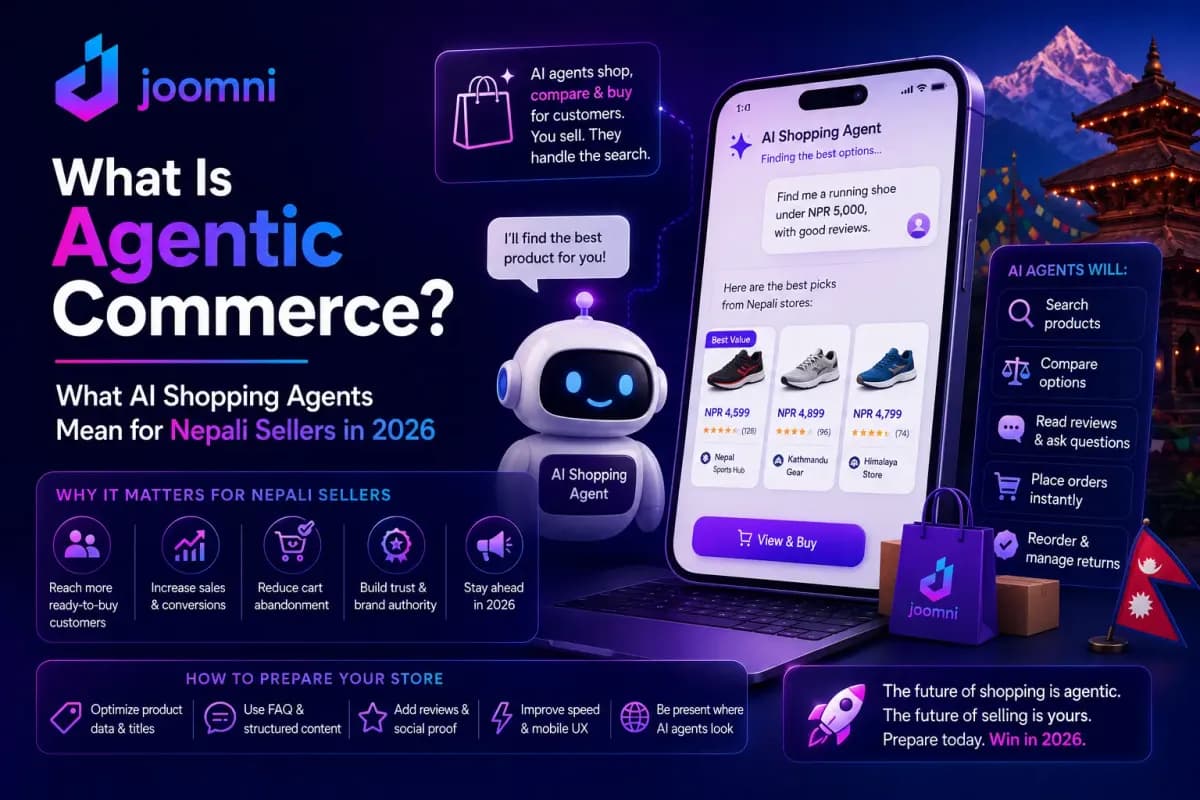
Imagine telling an AI assistant "find me running shoes for marathon training under 15,000 rupees," and the right pair arrives at your door, researched, compared, ordered, and paid for, without you doing anything after that first sentence.
That is agentic commerce, and the early version of it is already running.
The important question for a Nepali business is not whether this technology is impressive. It is which parts of it affect you now, which parts are years away here for structural reasons, and what you should actually do this year.
This guide answers all three, honestly. Some of what you will read elsewhere about agentic commerce does not translate to a market that runs on cash on delivery.
What's in this guide
- What agentic commerce actually is
- How it works
- What applies to Nepal now, and what does not
- How it differs from traditional ecommerce
- What this means for small businesses
- What to actually do this year
- Risks worth understanding
- Frequently asked questions
What Agentic Commerce Actually Is
Agentic commerce is when AI agents act on a person's behalf to research products, compare options, and complete purchases, with limited human involvement.
The word comes from "agency," meaning the capacity to act independently. This is the distinction from a chatbot or a recommendation engine, which respond to instructions. An agent works toward a goal.
A genuine agent can:
- Reason and plan. Take a broad goal and break it into steps.
- Act across systems. Search, compare, and transact without being prompted at each stage.
- Learn. Improve from outcomes and stated preferences.
- Coordinate. Run a multi-step process from discovery through checkout and delivery tracking.
Traditional ecommerce is user-driven: the customer searches, browses, compares, and clicks buy. Agentic commerce is goal-driven: the customer states an outcome and an agent works within set limits to reach it.
How It Works
Step 1, intent. The user states a goal in ordinary language: "I need a laptop for video editing under 150,000 rupees."
Step 2, interpretation. The agent works out both the explicit requirements and the implicit ones, in this case that video editing means particular processor, memory, and graphics needs.
Step 3, research. It searches across retailers, marketplaces, and product databases, comparing specifications, prices, reviews, and availability.
Step 4, evaluation. It weighs options against stated preferences, constraints, and past behaviour.
Step 5, transaction. Within limits the user has set, it completes the purchase, applies discounts, and picks shipping.
Step 6, afterwards. It tracks the order, handles delivery updates, and may manage returns or repeat orders.
Throughout, the user keeps control through permissions, spending limits, and approval thresholds. The agent takes on the work, not the authority.
What sits behind it
Language models that interpret intent and produce natural responses.
Agent frameworks that combine a model with tools, memory, and the ability to take actions.
Consumer platforms where people meet these agents, principally the major AI assistants.
Commerce infrastructure: machine-readable product data, real-time APIs for inventory and pricing, payment rails that support agent-initiated transactions, and the security to authenticate all of it.
That last item matters more than it sounds, and it is where Nepal's situation diverges sharply.
What Applies to Nepal Now, and What Does Not
This is the section international coverage of agentic commerce cannot write for you, and it is the most useful part of this article.
The structural obstacle: cash on delivery
Agentic commerce assumes an agent can complete a payment autonomously. That requires stored credentials, card-on-file, tokenised payment, and an authorisation model built for machine-initiated transactions.
Nepal's ecommerce runs substantially on cash on delivery. A large share of orders here are paid in physical cash at the door, by a customer who wanted to see the product first.
An AI agent cannot pay cash on delivery on your behalf. No amount of platform readiness changes that. Until digital payment adoption for online purchases rises substantially, the fully autonomous domestic purchase is not the near-term reality here that it is in markets where card payment is the default.
This is not a reason to ignore the shift. It is a reason to be clear-eyed about which half of it reaches you first.
What does apply to you right now
International buyers researching Nepali products. This is the immediate opportunity and it is significant.
Someone in Sydney planning a trek, someone in London buying pashmina, someone in New York sourcing handicrafts increasingly starts by asking an AI assistant. That agent researches, compares, and shortlists before the buyer has visited a single website.
If your products are not in machine-readable form with clear specifications, honest pricing, and real availability, you are not in that shortlist. For exporters, tourism businesses, and anyone selling Nepali goods abroad, this is happening now and almost none of your competitors have prepared for it.
Discovery and recommendation domestically. Even where an agent cannot complete the purchase, it can and does recommend. A Nepali customer asking an assistant where to buy something is a real and growing behaviour, and the answer gets built from whatever information those systems can find and trust.
This is Answer Engine Optimization territory, and it is the practical version of agentic readiness available to you today. Our guide to answer engine optimization covers the method in detail.
Agents on your own side of the counter. The other half of agentic commerce is agents working for the merchant rather than the customer: drafting product content, monitoring stock, answering customer questions, surfacing what your sales data shows. That is available now and does not depend on payment rails at all. Joomni's admin and storefront agents work this way, and our roundup of AI tools for Nepali stores covers the wider landscape.
The honest summary
Now: get discoverable and quotable by AI systems, particularly if you sell internationally. Use merchant-side AI to run your store better.
Later, and dependent on payment adoption: fully autonomous domestic purchasing.
Preparing for the first also prepares you for the second, which is why the work is worth doing now regardless.
How It Differs From Traditional Ecommerce
Customer journey. Traditional: the human browses, searches, and compares. Agentic: an agent discovers and evaluates.
Decision making. Traditional: manual comparison across tabs and sites. Agentic: automated analysis across many sources at once.
Purchase trigger. Traditional: a person clicks buy. Agentic: an agent executes within set parameters.
Data requirements. Traditional: human-readable descriptions and images. Agentic: machine-readable structured data.
Optimisation focus. Traditional: user experience design. Agentic: being findable, parseable, and quotable.
Customer interaction. Traditional: direct engagement with your brand. Agentic: mediated through an agent layer.
Loyalty. Traditional: built through brand relationship and marketing. Agentic: built through data quality and consistent reliability that agents come to trust.
That last line is the one to sit with. In an agent-mediated purchase, your brand story does far less work and your data accuracy does far more.
What This Means for Small Businesses
The playing field flattens somewhat. Agents weigh data quality, price, availability, and relevance more heavily than brand recognition. A small seller with excellent, accurate, well-structured product information can appear alongside far larger competitors, which is rarely true in advertising-driven discovery.
Discovery costs change shape. When agents do the finding, being the best-documented option in your category matters more than outspending anyone.
Friction falls. When an agent surfaces exactly the right product, the gap between wanting and buying narrows considerably.
Routine work moves off your desk. Agents handle repeat questions about specifications, availability, shipping, and returns, which frees you for the conversations that actually need a person.
International reach becomes achievable. Agents handle language and comparison across borders, which lowers a barrier that has kept many Nepali producers selling only domestically.
There is a real caveat attached to all of this. If the major AI platforms become the gatekeepers of product discovery, they hold the same structural power that marketplaces hold today: the ability to set terms, take a cut, and commoditise what they list. The lesson from Daraz vs your own website applies exactly here. Be present where discovery happens, but own the destination.
What to Actually Do This Year
Nothing on this list requires new technology or significant budget. All of it also improves your ordinary search performance, which is why it is worth doing even if agentic commerce moves slower than predicted.
1. Fix your product data
This is the foundation and most stores fail it.
Complete specifications. Materials, dimensions, weight, colours, sizes, compatibility, origin. Everything a buyer might filter or compare on.
Accurate stock and pricing, kept current. Agents skip sources they cannot trust. A listing that says available when it is not teaches a system to ignore you.
Structured data markup, particularly Product schema with price, availability, and ratings. This is how machines read your catalogue reliably rather than guessing from your page layout. SEO settings is where to check yours.
Consistency everywhere. If your product page and your specs table disagree, a system has no way to resolve it and will often skip you rather than risk being wrong.
Our catalogue setup guide covers the mechanics.
2. Write descriptions machines can quote
Complete factual statements rather than fragments. "This bag is made from water-resistant canvas with a 30 litre capacity" can be lifted into an answer. "Material: canvas" cannot.
Specificity beats enthusiasm. Concrete detail is what gets used. Our guide to writing product descriptions that rank covers this properly.
3. Collect and display reviews
Agents weight social proof heavily. Reviews on your own site and on Google both feed into how systems assess whether to recommend you. Ask every satisfied customer, and ask soon after delivery. Our local SEO guide covers the review-gathering methods that work in Nepal.
4. Make your business legible as an entity
Consistent name, address, phone number, and description everywhere online. Systems need to be confident who you are before they will recommend you.
5. Support digital payment properly
Cash on delivery is not going anywhere and you should keep offering it. But every customer who pays digitally is a customer an agent could eventually transact with, and building that habit now positions you for a market that will shift. Make eSewa, Khalti, and Fonepay genuinely easy at checkout rather than a secondary option.
6. Start small and measure
Ask the major AI assistants what they say about your products and your category. Note whether you appear and how you are described. Repeat monthly. That is a real visibility trend and it costs nothing.
Risks Worth Understanding
Privacy and consent. Agent-mediated shopping involves sharing preferences, history, and payment credentials. Be transparent about what you collect and why.
Accountability when things go wrong. If an agent orders the wrong item or exceeds an intended budget, responsibility is genuinely unsettled. Legal frameworks are behind the technology. Clear terms and a straightforward returns process protect you.
Platform concentration. If a handful of companies control agentic discovery, they gain the power to set terms and take margin, exactly as marketplaces did. Keep your own store as the asset you own.
Bias in recommendations. These systems reflect their training data. Whether that disadvantages smaller or non-Western sellers is an open question worth watching, particularly for Nepali producers selling internationally.
Trust is fragile. If agent-driven purchases go wrong often enough, adoption stalls. This shift may well move slower than the forecasts suggest, which is another reason to prefer preparation that also pays off in ordinary search.
Frequently Asked Questions
Will agentic commerce replace ecommerce websites?
No. It adds a discovery and purchase layer on top. People will still browse directly, particularly for considered purchases where they want to look properly. Your site remains where the sale completes and where you own the relationship.
Does this affect Nepali businesses yet?
Partly. If you sell to international customers, yes, and now, because buyers abroad increasingly research through AI assistants before finding any website. Domestically it is earlier, largely because cash on delivery still carries a large share of orders and an agent cannot pay cash at your customer's door.
How do I know if my business is ready?
Three questions. Is your product data complete, accurate, and structured? Can systems read your prices and stock reliably? Is your business information consistent everywhere online? If yes to all three, you are ahead of almost every competitor here.
What is the biggest risk of ignoring it?
Not being present when discovery happens. If AI systems cannot find, parse, or trust your information, you are absent from a growing share of buying decisions regardless of how good your products are.
What does it cost to prepare?
For most small stores, nothing but time. Complete product data, structured markup, consistent business information, and collected reviews are all things you should be doing anyway. Modern platforms handle the technical markup automatically. See our pricing.
Can a small Nepali business compete with large retailers here?
Better than in most channels, yes. Agents weigh data quality, price, availability, and relevance above brand recognition and advertising budget. A well-documented small store genuinely can be recommended over a poorly documented large one.
How do I measure whether this is working?
Ask the AI assistants your customers would use, monthly, and record what they say. Watch branded search in Google Search Console, since people who discover you through an assistant often search your name afterwards. And check your analytics for referral traffic from AI platforms.
The Bottom Line
Agentic commerce is a genuine shift, and it will reach Nepal in two stages rather than one. Discovery and recommendation are already here, particularly for anyone selling internationally. Fully autonomous purchasing waits on payment habits that are changing but have not changed yet.
The good news is that the preparation is the same either way, and none of it is exotic. Accurate structured product data. Descriptions written in complete factual sentences. Real reviews. Consistent business information. Digital payment made easy.
Every one of those improves your ordinary search performance today, whatever pace the agents move at.
Building a store that machines and customers can both read? Start with Joomni, or compare plans.
Nepali ma padhna man cha? Hamro website kasari banaune guide hernuhos.
Written by
Admin